The kidneys are often spoken of as filters, but that is only part of the picture. They regulate fluid balance, electrolyte levels, and the removal of metabolic byproducts. They also participate in blood pressure control and signal pathways that influence red blood cell production. When the kidneys are under stress, the effects are rarely isolated. They tend to ripple through multiple systems at once.
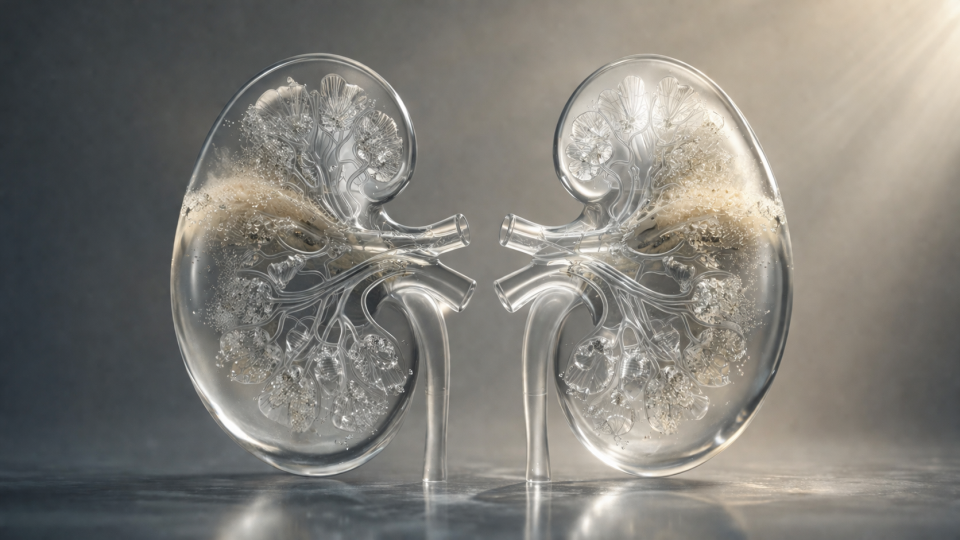
People commonly use the phrase “kidney disease” as if it were a single condition, but it is not. It is a category that includes several different patterns:
- Acute kidney stress (AKI) — a sudden change in function, often related to dehydration, infection, or medication effects
- Chronic kidney patterns (CKD) — a gradual decline over time, frequently associated with long-standing metabolic or vascular stress
- Glomerular involvement — where the filtering units themselves are affected
- Tubular or interstitial patterns — where fluid handling and transport are altered
- Metabolic contributors — such as those related to blood sugar, blood pressure, or mineral balance
Each pattern has its own trajectory. The common thread is load—how much the kidneys are asked to manage, and how efficiently they can do it.
People often describe:
- fluid retention or changes in swelling
- shifts in urination patterns (frequency, color, or volume)
- fatigue that feels deeper than usual
- changes in blood pressure patterns
- a sense that recovery from stress takes longer
In early stages, these signals may be subtle. In later stages, they can become more pronounced and require close medical supervision.
From a systems perspective, the kidneys are balancing several competing demands:
- clearing metabolic waste
- maintaining electrolyte stability
- regulating fluid distribution
- responding to inflammatory signaling
- adapting to changes in blood flow and pressure
When the system is under sustained load—whether from metabolic factors, inflammatory signaling, or reduced perfusion—the kidneys may continue to function, but with less margin.
Over time, this can feel like the body is working harder to maintain the same baseline.
One of the more consistent observations in this area is variation.
Different people experience different patterns.
Different conditions progress at different rates.
Different environments produce different responses.
This variability often leads to confusion when people begin comparing approaches.
What works in one context does not always translate directly to another.
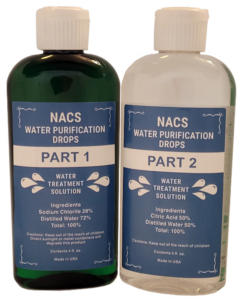
In alternative discussions, chlorine dioxide is sometimes explored in relation to internal environmental load, particularly where there is interest in microbial balance and oxidative chemistry.
It is not typically described, in careful circles, as a direct answer to kidney conditions. Rather, it is discussed in terms of how it might relate to background factors that influence the overall system.
Some individuals report that, when exploring chlorine dioxide cautiously, they are paying attention to broader patterns such as:
- whether their overall sense of burden feels lighter or heavier
- whether recovery from general stress improves or remains unchanged
- whether systemic signals—like fatigue or fluid balance—shift over time
These are personal observations, not uniform outcomes.
It becomes clear quickly that there is no single way people approach this topic.
Some prefer structured methods.
Others take a more incremental, observational path.
Some focus on timing.
Others focus on environmental factors.
There are also voices that insist there is only one correct method.
In practice, that kind of rigidity does not reflect what most people actually experience.
Biological systems are variable.
So are human responses.
What tends to matter more is the quality of observation:
- starting cautiously
- paying attention to the body’s response
- allowing time between changes
- avoiding anything that produces clear discomfort or strain
The emphasis, in careful discussions, is not on forcing outcomes, but on learning how the body responds.
It is understandable that people feel uncertainty around this topic.
Public messaging has, at times, been strong and cautionary. Comparisons are made that can sound alarming when taken at face value.
At the same time, chlorine dioxide is widely recognized in other contexts—particularly in water treatment—as a tool for making questionable water safer.
These two realities can feel contradictory.
For many people, the result is hesitation.
And hesitation, in itself, is not a bad thing.
It often leads to deeper research, more questions, and more careful consideration.
Across many conversations, people continue to emphasize simple fundamentals:
- maintaining hydration
- supporting stable electrolyte balance
- allowing sufficient rest
- avoiding unnecessary strain on the system
- working with qualified professionals when conditions are significant
These are not complex strategies, but they tend to influence how the body manages load.

Kidney conditions are not defined by a single pathway.
They reflect how the body manages accumulation, balance, and flow over time.
In that context, people explore different ideas, different approaches, and different frameworks.
Some of those include chlorine dioxide as part of a broader conversation.
But the consistent theme, across careful observers, is this:
There is no single path that applies to everyone.
There is only the process of paying attention, adjusting thoughtfully, and respecting the signals the body provides.
Important Note
This material is presented for informational purposes only. Kidney conditions can be serious and often require professional medical care and monitoring. Chlorine dioxide is not approved for internal therapeutic use by regulatory agencies. Health decisions should be made in consultation with qualified professionals.
Leave a Reply