One of the things I’ve learned over the years is that nature rarely fits into simple categories. People want to know whether something is good or bad, safe or dangerous, helpful or harmful. Nature usually answers: “It depends.” Take sunlight. Too much can burn your skin. Too little can leave you unhealthy. The difference is often the amount. Water is the same way. Too little and you die. Too much in a short period can also be dangerous. Dose matters.
The same principle applies to many things we encounter every day. That’s why I’ve always found the conversation around chlorine dioxide fascinating.
Two Very Different Conversations
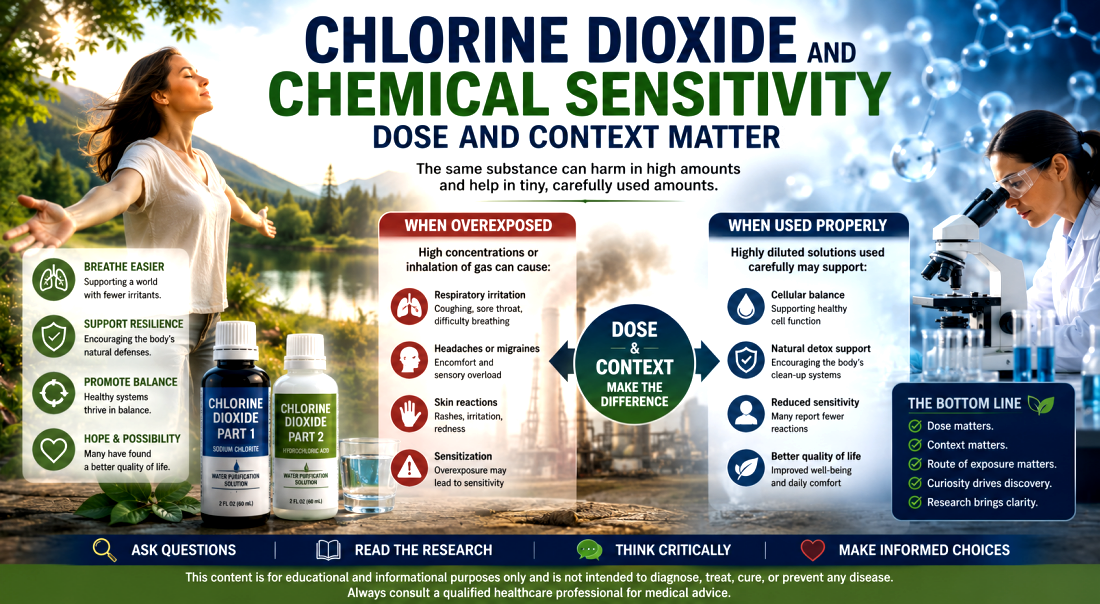
If you search online for chlorine dioxide and chemical sensitivity, you’ll quickly find warnings about coughing, irritated lungs, sore throats, headaches, and skin irritation.
Most of those warnings come from discussions about high-concentration occupational exposure, accidental releases, or inhalation of chlorine dioxide gas in industrial settings.
Those are important safety discussions. No one should ignore them. At the same time, there is another conversation taking place among people who use chlorine dioxide water purification drops in highly diluted amounts. Some report that they feel less reactive to everyday environmental exposures over time. Those observations are interesting.
Whether they represent cause and effect—or whether other factors contribute—is a question that deserves careful scientific investigation.
The Dose Makes the Difference
One of the oldest ideas in science is that dose matters. Almost anything can become harmful in excessive amounts. Many things that are useful in one setting become dangerous in another. That doesn’t automatically mean small amounts are beneficial. Nor does it mean they are harmful. It means we have to be careful about assuming that one situation explains every other situation.
Context matters. Concentration matters. Route of exposure matters.
Questions Worth Asking
Could chlorine dioxide influence the body’s response to environmental chemicals? Many people believe it does.
Could the improvements they describe be related to changes in lifestyle, diet, stress reduction, or other factors? That is also possible.
Could multiple factors be working together? Certainly.
These are exactly the kinds of questions that science is designed to investigate.
Curiosity Before Conclusions
Throughout my life I’ve watched many ideas move from impossible… to controversial… to accepted. I’ve also watched many exciting ideas fail careful testing. Both outcomes teach us something.
That’s why I encourage people to stay curious without becoming careless.
Hope is valuable. So is healthy skepticism. The two are not enemies. They’re partners in discovery.
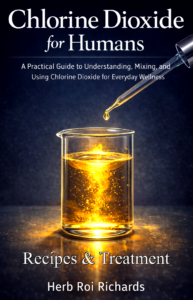
Chemical Sensitivity is covered in more detail in my book, Chlorine Dioxide for Humans: Recipes & Treatment
Companion products also include: Oceanic Magnesium, Pascalite Clay, Aloe Vera, Apple Cider Vinegar, Flaxseed Oil, and Lugol’s Iodine.
If chlorine dioxide has something meaningful to contribute to understanding chemical sensitivity, careful research will eventually reveal it. If it does not, good research will reveal that too. Either way, we all benefit from asking better questions. Because progress doesn’t begin with certainty. It begins with curiosity.
~ Herb Roi Richards
Leave a Reply