What’s the difference, and why do the drop comparisons seem so confusing? Spend enough time around people who use chlorine dioxide, and eventually somebody asks: “How much CDS equals one activated drop?” Then the fun begins. One person says eight drops. Another says ten. Someone else starts talking about milliliters. Before long, a fairly simple question sounds as though you need a chemistry degree and laboratory equipment to answer it.
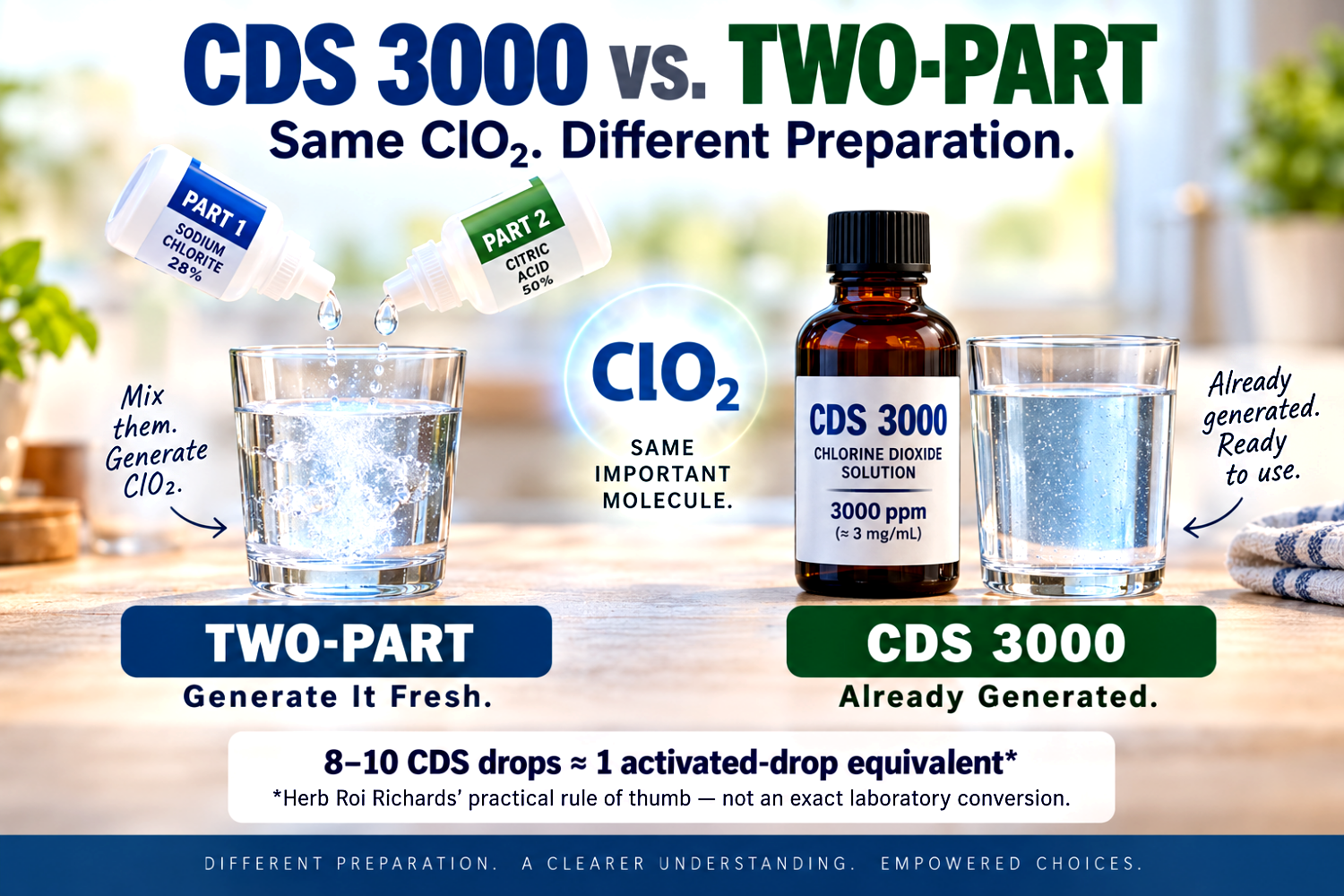
Fortunately, the basic difference between the two preparations isn’t nearly that complicated. Both approaches involve the same important molecule: chlorine dioxide, or ClO₂. The biggest difference is how that chlorine dioxide gets into the water. And once we understand that, Herb Roi Richards’ familiar rule of thumb—about 8 to 10 drops of CDS 3000 for one activated-drop equivalent of the two-part system—becomes easier to understand for what it is: A practical comparison, not an exact laboratory conversion.
First, What Is the Two-Part System?
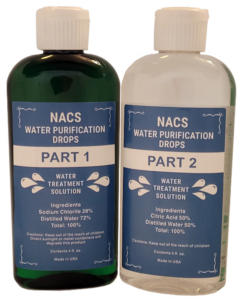
The familiar two-part water-purification system starts with two separate bottles.
Part 1 contains sodium chlorite.
Part 2 contains an acid activator, such as citric acid.
The two are kept apart until they are needed. When drops from the two bottles are combined, a chemical reaction begins and chlorine dioxide is generated. That’s why people call it “activating” the drops.
You aren’t simply pouring chlorine dioxide out of the Part 1 bottle. You’re making it.
That’s an important distinction.
What Is CDS 3000?
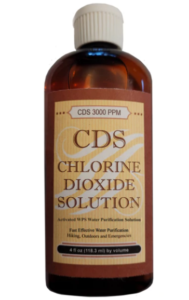
CDS takes a different approach. The letters CDS commonly refer to chlorine dioxide solution.
Instead of carrying the original sodium chlorite and acid together in the final product, chlorine dioxide is generated beforehand and captured in water. So the chemistry has already happened elsewhere.
When properly prepared at its intended concentration, CDS 3000 refers to a solution targeting approximately 3,000 parts per million of chlorine dioxide. That’s approximately 3 milligrams of chlorine dioxide per milliliter of solution.
So we have two rather different starting points:
Two-Part
Precursors → mix them → chlorine dioxide begins forming
CDS 3000
Chlorine dioxide already generated → captured in water → stored as a solution
Same important molecule. Different way of getting there.
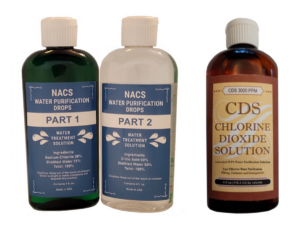
2-Part Chlorine Dioxide Kit vs. CDS 3000
Two-Part Water Purification Drops |
CDS 3000 |
| Made from sodium chlorite plus an activator | Chlorine dioxide has already been generated |
| ClO₂ begins forming when the two parts are mixed | ClO₂ is already dissolved in the water |
| Freshly activated when needed | Prepared ahead of time |
| The mixture can contain generated ClO₂, remaining chlorite and other reaction products | Intended primarily to provide dissolved ClO₂ without consuming the original activating ingredients together |
| Some remaining chlorite may undergo additional reactions later | No intentional second activation step is required |
| Herb uses 1 activated-drop equivalent ≈ 8–10 drops CDS 3000 as a practical rule of thumb | Herb uses 8–10 drops ≈ 1 activated-drop equivalent as a practical comparison |
| Think: freshly generated chemistry | Think: already-generated ClO₂ in water |
Why Isn’t One Drop Simply One Drop?
Because we’re measuring two different things.
- A drop of CDS 3000 is a drop of water containing an already-established concentration of chlorine dioxide.
- A “drop” in the two-part method usually refers to the amount of precursor used to make chlorine dioxide.
Those aren’t equivalent measurements. It’s a little like comparing a spoonful of coffee beans with a spoonful of brewed coffee. They’re related. But they aren’t measuring the same stage of the process.
The Two-Part Mixture Doesn’t Instantly Become Pure Chlorine Dioxide
Here’s where things get particularly interesting. When sodium chlorite and an acid activator are combined, chlorine dioxide begins forming. But that doesn’t mean every molecule of sodium chlorite instantly becomes chlorine dioxide. The reaction depends upon several things, including concentration, acidity, temperature, and reaction time.
That means a freshly activated two-part mixture may contain: chlorine dioxide + remaining chlorite + other reaction products.
This isn’t particularly mysterious. It’s chemistry. It also helps explain why trying to convert two-part drops into CDS 3000 drops with absolute precision can become frustrating.
You’re comparing a reaction in progress with an already-prepared solution.
What About Further Activation Inside the Body?
This idea frequently comes up in chlorine dioxide discussions. Because some chlorite can remain after the initial activation period, people sometimes describe the two-part method by saying: “It finishes activating in the stomach.”
There is a reasonable chemical idea hiding inside that statement, but it is probably too definite.
The stomach is acidic, and remaining chlorite can undergo additional chemical reactions in acidic environments. But the stomach isn’t a laboratory chlorine-dioxide generator. It contains food, proteins, acids and many other substances that can participate in chemical reactions.
So a more accurate way of saying it is: Some chlorite may remain after the initial two-part activation and may undergo additional chemical reactions later in an acidic digestive environment.
Exactly how much becomes chlorine dioxide after ingestion shouldn’t be treated as a known or predictable “second activation.”
Still, this is one genuine difference between the two preparations.
- With CDS 3000, the chlorine dioxide has already been generated before use.
- With the two-part method, you’re dealing with freshly generated chlorine dioxide plus precursor chemistry that may not have completely finished reacting.
So Where Does the 8-to-10-Drop Rule Come From?
Herb Roi Richards commonly uses this simple comparison:
About 8–10 drops of CDS 3000 ≈ 1 activated-drop equivalent of the two-part system.
It’s important to understand what that means. This isn’t the same thing as saying: “Laboratory analysis proves that exactly 9.000 drops of CDS 3000 always equal exactly one activated drop.” It doesn’t.
It’s a field rule of thumb.
And there are several reasons an absolutely exact conversion isn’t realistic. Drops aren’t perfectly standardized. Different droppers produce slightly different drop sizes. Two-part activation varies with conditions.
CDS 3000 concentration can change during storage. Temperature matters. Light matters. Time matters.
Even two bottles marked “CDS 3000” aren’t necessarily guaranteed to contain precisely the same concentration at every moment of their lives.
So 8–10 drops shouldn’t be mistaken for laboratory precision. That’s why it’s a range.
CDS 3000 Has One Big Measurement Advantage
CDS 3000 has something the two-part recipe doesn’t automatically give us: a stated concentration.
If CDS actually measures 3,000 ppm, then approximately: 1 milliliter contains 3 milligrams of dissolved chlorine dioxide.
That’s a genuine concentration measurement.
“One activated drop,” on the other hand, is really a recipe measurement.
It tells us how much starting material was used. It doesn’t independently tell us exactly how much ClO₂ exists in the finished glass at that moment.
That distinction explains an enormous amount of the confusion surrounding conversion charts.
Why Does CDS Need Special Storage?
Chlorine dioxide doesn’t particularly enjoy hanging around waiting for us. It is reactive and volatile. Light, warmth, storage conditions, headspace, opening the container, and time can all influence a prepared solution.
That’s why CDS is generally protected from light and excessive warmth and handled in ways intended to preserve its concentration.
The two-part approach has a different advantage. The starting materials remain separate until they’re needed. Then chlorine dioxide is freshly generated.
This leads some people to prefer CDS for convenience and others to prefer two-part systems for freshly generated chlorine dioxide.
Neither preparation magically changes the identity of ClO₂.
ClO₂ is still ClO₂. The surrounding chemistry and method of preparation are what differ.
Is CDS “Weaker”?
This is another common description that can be misleading. Someone might say: “I use CDS 3000 because it’s weaker.”
What they generally mean is that a small volume of CDS 3000 can represent less chlorine dioxide exposure than the amount associated with a particular two-part recipe.
The chlorine dioxide molecule itself hasn’t become weaker. A molecule of ClO₂ doesn’t know which bottle it came from. What changes is concentration and quantity.
Think about salt water. A teaspoon of salt dissolved in a swimming pool and a teaspoon dissolved in a glass both contain salt. The concentration is dramatically different.
Don’t Let the Drops Drive You Crazy
This might be the most useful lesson of all. People sometimes become so concerned about tiny differences in drop counts that you’d think accidentally adding one extra drop was going to leave a smoking crater where the kitchen used to be.
That’s not a particularly useful way to understand these products. At the same time, chlorine dioxide and concentrated sodium chlorite aren’t substances for which “more must be better” is a sound principle.
The sensible middle ground is recognizing that drop-based recipes are approximate by nature, while still respecting concentration, preparation instructions and the chemistry involved.
Two Preparations. One Important Molecule.
The simplest way to remember all of this may be:
Two-Part
Make the chlorine dioxide when you need it.
CDS 3000
The chlorine dioxide has already been made and dissolved in water.
That’s really the heart of the difference.
The two-part approach begins with concentrated precursor chemistry and generates chlorine dioxide at the time of preparation.
CDS 3000 separates the generation process from the finished solution and gives us already-generated chlorine dioxide dissolved in water.
Herb’s 8–10 drops of CDS 3000 for approximately one activated-drop equivalent can therefore be understood as what it was intended to be: A convenient field comparison. Not an analytical chemistry equation.
Not a promise that every bottle, dropper, and activation will produce identical results. And not something that needs to turn an otherwise simple conversation into an advanced chemistry class.
The Part Worth Remembering
If you’re standing there staring at two bottles and wondering why everybody makes this sound so complicated, remember three things:
CDS 3000 already contains generated chlorine dioxide.
The two-part system generates chlorine dioxide when its ingredients are mixed and may still contain unreacted precursor afterward.
And:
Herb’s 8–10-to-1 comparison is best thought of as a general rule of thumb, not an exact conversion.
Once we stop asking a recipe measurement to behave like a laboratory measurement, most of the apparent contradiction disappears. And maybe that’s all the chemistry most of us really wanted to know in the first place.

Frequently Asked Questions About CDS 3000 and Two-Part Chlorine Dioxide
What is CDS 3000?
CDS stands for chlorine dioxide solution. The chlorine dioxide has already been generated and captured in water. “3000” refers to a target concentration of approximately 3,000 ppm chlorine dioxide.
In simple terms: the chlorine dioxide is already made.
What is two-part chlorine dioxide?
The two-part method starts with separate ingredients. Part 1 contains sodium chlorite, while Part 2 contains an acid activator, such as citric acid.
When the two are mixed, a reaction begins that generates chlorine dioxide.
In simple terms: you make the chlorine dioxide when you need it.
Are CDS 3000 and two-part chlorine dioxide the same thing?
Not exactly. They both involve the same important molecule—chlorine dioxide (ClO₂)—but they arrive there differently.
CDS contains chlorine dioxide that has already been generated and dissolved in water. A two-part system generates chlorine dioxide when the two ingredients are combined and may also contain remaining chlorite and other reaction products.
How many drops of CDS 3000 equal one activated drop?
Herb Roi Richards uses a practical rule of thumb of approximately:
8–10 drops of CDS 3000 ≈ 1 activated-drop equivalent of the two-part system.
This is best understood as a general field comparison, not an exact laboratory or dosing conversion. Drop size, activation conditions, and the actual concentration of CDS can vary.
Why isn’t there an exact conversion?
Because the two measurements aren’t quite measuring the same thing.
CDS 3000 describes a target concentration of already-generated chlorine dioxide.
An “activated drop” is essentially a recipe measurement describing how much precursor was used to generate chlorine dioxide.
That’s why conversion charts should be treated as approximate.
Is the two-part mixture completely activated before it is used?
Not necessarily. Chlorine dioxide begins forming when sodium chlorite and the activator are combined, but the reaction doesn’t necessarily convert all of the starting material immediately.
The finished mixture can therefore contain chlorine dioxide, remaining chlorite, and other reaction products.
Can the remaining chlorite continue reacting in the digestive system?
Remaining chlorite can undergo additional chemical reactions in acidic environments, so the idea has a chemical basis. However, the stomach and intestines are much more complicated than a laboratory container. Food, proteins, acids and many other substances are present.
For that reason, it is better to say that remaining chlorite may undergo additional reactions in the digestive environment rather than claiming that the stomach simply “finishes activating” it into a predictable amount of chlorine dioxide.
Is CDS 3000 weaker than two-part chlorine dioxide?
Not exactly. The chlorine dioxide molecule itself isn’t weaker simply because it came from CDS.
What differs is the concentration, quantity, and surrounding chemistry.
When people describe CDS as “weaker,” they are usually comparing a particular amount of CDS with a particular two-part preparation—not describing a different kind of chlorine dioxide.
Why does CDS 3000 need careful storage?
Chlorine dioxide is reactive and volatile. Light, warmth, time and handling can gradually affect a prepared solution.
That is why CDS is commonly stored cool, protected from light and in an appropriate tightly closed container.
The two-part approach avoids some of this issue because its ingredients remain separate until chlorine dioxide is generated for use.
Does CDS need to be activated before use?
No. That’s one of its defining differences.
With CDS, the chlorine dioxide has already been generated and dissolved in the water.
The two-part system requires the two components to be combined to begin generating chlorine dioxide.
Does an extra drop completely change everything?
Drop-based recipes are naturally approximate because individual drops aren’t perfectly identical.
That doesn’t mean concentration should be ignored or that more is automatically better. It simply means that a drop should not be mistaken for the kind of precision produced by laboratory measurement.
Which is better: CDS 3000 or two-part chlorine dioxide?
They are better thought of as different preparations rather than competing versions of exactly the same product.
Some people prefer the convenience of already-prepared CDS. Others prefer generating chlorine dioxide fresh with a two-part system.
Understanding what each preparation actually contains is more useful than assuming that one must always be superior to the other.
What is the easiest way to remember the difference?
Just remember:
Two-Part = Generate It Fresh
CDS 3000 = Already Generated
And when comparing them using Herb Roi Richards’ approach:
8–10 drops CDS 3000 ≈ 1 activated-drop equivalent*
*A practical rule of thumb, not an exact laboratory or dosing conversion.
Informational Notice
This article explains differences between chlorine-dioxide preparations and terminology used by Herb Roi Richards and within the chlorine-dioxide community. The 8–10-drop comparison is a field rule of thumb, not a clinically validated dosing equivalence. Chlorine dioxide and sodium chlorite are reactive chemicals; concentration, preparation and route of exposure matter. This article is informational and should not be interpreted as instructions for treating disease or as a recommendation to ingest chlorine dioxide or sodium chlorite.
Leave a Reply