In December 2013, Chinese inventor Liu Xuewu filed a patent proposing that chlorine dioxide might have applications beyond its established antimicrobial properties. His investigation focused on a fundamental biological process known as apoptosis, often described as programmed cell death.
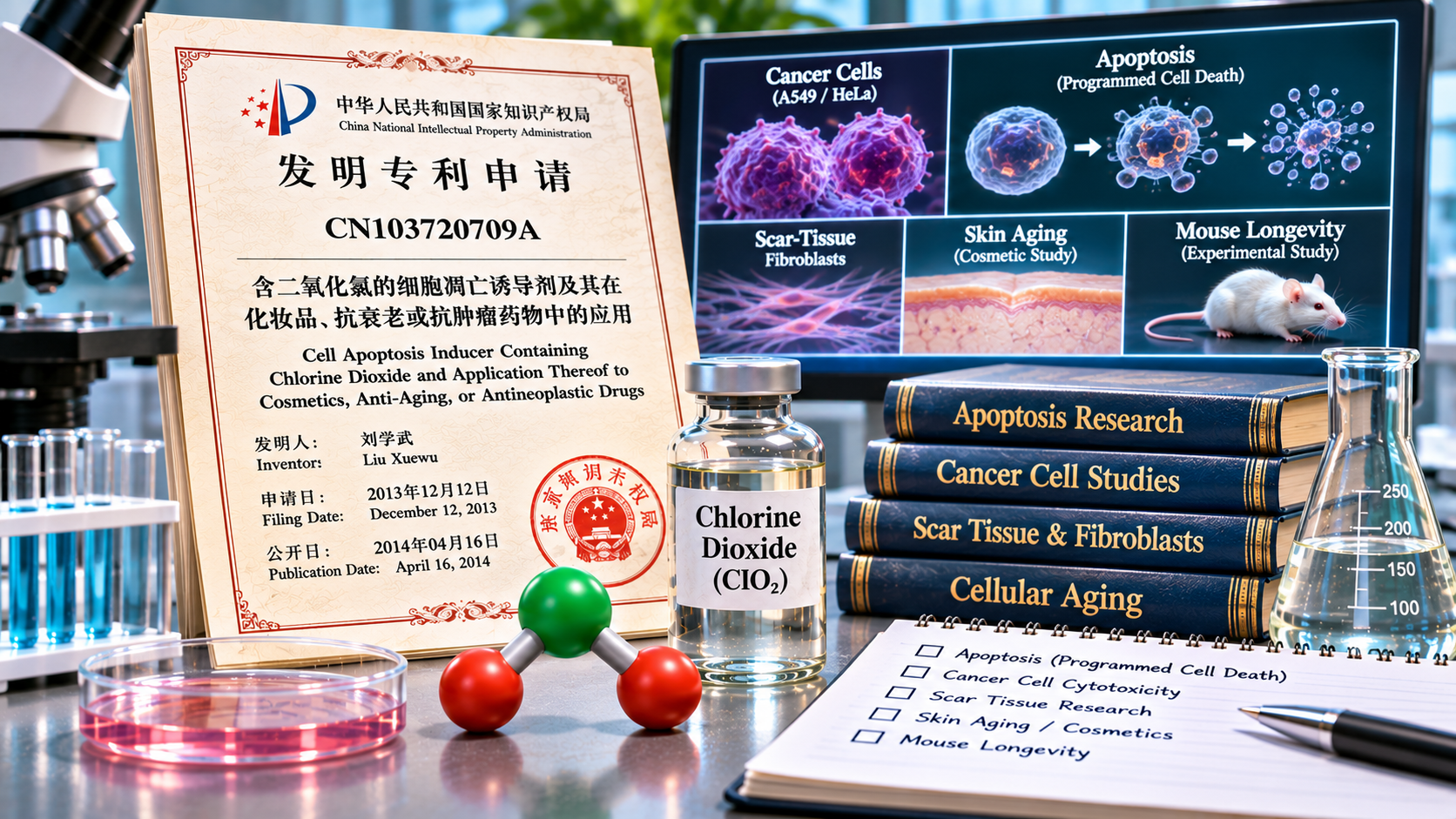
Apoptosis is one of the body’s natural mechanisms for removing unwanted, damaged, or unnecessary cells. It plays important roles in normal development, tissue maintenance, and the regulation of cell populations. The process is also relevant to cancer research.
Many cancer cells acquire mechanisms that allow them to resist the normal signals that would otherwise cause damaged or abnormal cells to die.
Liu proposed that chlorine dioxide-containing formulations might influence this process.
His patent described experiments involving human scar-tissue fibroblasts, several cultured cancer-cell lines, skin applications, and mouse longevity.
The invention was published in April 2014 under the number CN103720709A. Although its medical proposals were expansive, the patent contains specific experimental observations that can be examined independently.
The central question is whether the reported effects represent selective regulation of programmed cell death or more general chemical injury caused by an oxidizing substance.
Understanding that distinction is essential to interpreting the invention.
The Patent and Its Inventor
The principal document is:
The patent identifies Liu Xuewu (刘学武) as inventor.
Its recorded history includes:
| Event | Date |
| Chinese priority and filing | December 12, 2013 |
| Patent application published | April 16, 2014 |
| Patent publication | CN103720709A |
| Applicant | Individual inventor |
The available patent database lists the application as pending, although that automated legal-status information should not be treated as an authoritative determination of current patent rights.
The invention addressed three broad areas:
- Influencing apoptosis in abnormal or unwanted cells.
- Investigating possible applications involving aging and tissue appearance.
- Exploring whether chlorine dioxide-containing formulations could affect malignant cells.
These applications share a common biological theme.
The inventor believed that influencing the survival of particular cell populations might produce effects in tissues where abnormal cell persistence contributed to disease or aging.
Understanding Apoptosis
To understand the patent, it helps to distinguish apoptosis from other forms of cell death. Cells can die through several mechanisms. Some forms of cell death are associated with severe injury, membrane disruption, and the release of cellular contents.
Apoptosis is generally a more organized biological process involving coordinated changes inside a cell. These changes can include alterations in mitochondrial function, activation of specialized enzymes, condensation of genetic material, and fragmentation of the cell into structures that can be cleared by surrounding tissues.
Apoptosis is not automatically beneficial or harmful. Its significance depends on which cells are affected and why.
Removing an abnormal cancer cell may be desirable. Causing unnecessary death of healthy cells may damage tissues.
Likewise, insufficient apoptosis can contribute to certain diseases, while excessive apoptosis can contribute to others.
The patent’s central hypothesis was that chlorine dioxide-containing preparations might promote apoptosis in selected abnormal cell populations.
Whether the effect was selective remained a separate experimental question.
The Inventor’s Theory of Cellular Aging
Liu’s patent connected apoptosis to the biology of aging. The inventor argued that aging tissues may accumulate cells that no longer function normally but resist removal. He proposed that encouraging the elimination of these cells could permit healthier tissue renewal.
This reasoning resembles an area of modern aging research involving cellular senescence. Senescent cells are cells that have entered a persistent state of growth arrest and may develop altered patterns of inflammatory signaling and metabolism. Some senescent cells resist apoptosis.
Researchers have investigated whether selectively eliminating particular senescent cells might influence age-related biological changes.
However, senescence and apoptosis are different processes. A senescent cell is not necessarily dead or dying, and not every aging cell is senescent.
The patent tended to connect aging, apoptosis resistance, and tissue renewal more broadly than current evidence supports. Its underlying research question remains recognizable: can unwanted cell populations be removed without disrupting healthy tissue?
The inventor proposed chlorine dioxide as one possible means of influencing that process.
Experiment One: Human Scar-Tissue Fibroblasts
One of the patent’s first experimental sections concerns hypertrophic scars. Hypertrophic scars develop when wound-healing processes produce excessive scar tissue.
Fibroblasts are important cells in this process because they participate in producing collagen and other components of connective tissue.
The inventor reasoned that abnormal persistence of fibroblasts might contribute to excessive scarring.
The Tissue Samples
The patent reports obtaining scar-tissue samples from six individuals. Five were male, and one was female. Their reported average age was 42 years.
The researchers separated tissue into several categories, including the center and edge of the scar, surrounding skin, and normal skin from other locations.
Fibroblasts were cultured from these samples. The researchers then compared cellular responses under different experimental conditions.
The Apoptosis Measurements
The patent describes using flow cytometry and propidium iodide staining to investigate changes associated with cell death. It also describes a comparison involving a Fas-related apoptosis stimulus.
The inventor reported that fibroblasts from scar tissue showed greater resistance to apoptosis than fibroblasts from normal skin under certain experimental conditions.
The chlorine dioxide-containing preparation was then tested against the cultured cells.
According to the patent, the proportion of cells classified as apoptotic increased as the concentration of the preparation increased.
The inventor interpreted this as evidence that the formulation could promote apoptosis in scar-tissue fibroblasts.
What the Experiment Suggests
The experiment provides a laboratory observation involving human-derived cells. However, an increase in cells classified as apoptotic does not, by itself, establish selective removal of abnormal fibroblasts.
The researchers would also need to determine whether the preparation caused comparable damage to normal fibroblasts.
The chemical composition of the preparation matters as well. The tested solution was produced through an acid-activated chlorite system, meaning the biological effects could potentially involve chlorine dioxide alongside other chemical species and acidity. The reported experiment does not fully isolate these contributions.
Nevertheless, the scar-tissue investigation is important because it shows how the inventor developed his broader apoptosis hypothesis.
Experiment Two: Observations Involving Scar Tissue
The patent also describes direct application of the experimental formulation to hypertrophic scar tissue. The inventor reported changes in scar appearance during subsequent observation.
The account describes surface changes, crust formation, healing, and gradual flattening of treated scar tissue.
The researchers also examined tissue samples using histological methods.
One method was the TUNEL assay, which detects DNA fragmentation associated with certain forms of cell death. The patent reports increased TUNEL-positive staining following treatment.
The inventor interpreted these findings as further evidence that the preparation promoted apoptosis.
A Question of Interpretation
The reported observations are interesting, but they raise an important distinction. A chemically reactive substance may produce tissue injury followed by wound healing and remodeling. Such remodeling can alter the appearance of a scar.
That does not necessarily mean the substance selectively corrected the underlying biology of hypertrophic scarring.
Similarly, TUNEL staining can identify DNA fragmentation, but it is not exclusively specific to apoptosis.
Additional measurements are needed to distinguish programmed cell death from other forms of cellular injury.
The patent’s scar observations therefore document reported tissue changes without conclusively establishing the mechanism responsible.
Experiment Three: Skin Aging and Cosmetic Applications
The invention also explored cosmetic applications. The patent describes observational testing involving a chlorine dioxide-containing skin preparation.
One section reports evaluations involving 100 women.
Another describes a smaller group consisting of 30 women and 10 men.
The researchers examined several aspects of skin appearance and condition. These included moisture, elasticity, smoothness, skin tone, and fine lines.
The patent refers to instruments used to measure skin hydration and elasticity.
The inventor reported improvements in several measured or observed characteristics.
How Strong Is the Evidence?
The reports are relevant as historical accounts of product investigation. However, the patent does not establish that the observations came from adequately blinded, randomized, controlled cosmetic trials.
Skin appearance and hydration can change for many reasons. These include the effects of the formulation’s carrier ingredients, environmental conditions, normal biological variation, and measurement procedures.
Without a suitable comparison preparation, it is difficult to determine which component produced an observed change.
The patent’s cosmetic findings therefore remain preliminary observations. They do not establish that chlorine dioxide reverses biological aging.
Experiment Four: Acne Observations
The patent describes another small investigation involving individuals with acne. Thirty participants were included. The inventor reported that many experienced improvement during a short observation period.
The patent attributed the proposed benefit to a combination of antimicrobial activity and removal of unwanted skin cells.
This explanation involves two distinct mechanisms.
The first is antimicrobial activity against microorganisms associated with acne.
The second is the proposed influence on cellular turnover.
However, acne is a complex inflammatory condition involving follicles, sebum production, microbial interactions, and immune responses.
The patent does not provide enough controlled clinical evidence to establish the relative contribution of these mechanisms.
The reported improvement is an observation from the patent, not proof that the formulation is an effective or appropriate acne treatment.
Experiment Five: Mouse Longevity
One of the most unusual parts of the patent concerns an experiment involving the lifespan of mice.
The inventor described an investigation using 100 male C57BL/6 mice. The animals were divided into two groups of 50. One group served as the comparison group. The other received the experimental formulation through repeated intravenous administration.
The patent reports that the treated animals lived longer on average.
Reported Lifespan Results
| Measurement | Comparison group | Experimental group |
| Average lifespan | 696.5 days | 778.3 days |
| Reported maximum-lifespan measure | 932 days | 987.5 days |
The inventor described the difference in average lifespan as approximately 11%.
He also reported an increase of approximately 5.9% in the measure used to represent maximum lifespan.
These are specific numerical claims in the patent.
What the Results Would Mean If Reproduced
An increase in lifespan in a controlled animal experiment can be scientifically significant. However, interpreting such findings requires detailed information about randomization, animal husbandry, disease incidence, causes of death, and statistical analysis.
It is also important to distinguish lifespan extension from evidence of a particular anti-aging mechanism.
Even if an intervention changed lifespan, that would not establish that it worked by selectively removing senescent cells.
The patent does not provide enough independent mechanistic evidence to establish that explanation. Nor do the results demonstrate that intravenous chlorine dioxide is safe or effective in humans.
The mouse experiment is best regarded as a reported preclinical finding requiring independent replication.
Additional Mouse Behavior Experiments
The patent also describes behavioral tests involving a subset of the mice. The inventor used water-maze and balance-related tasks to investigate performance. He reported differences favoring the experimental group in certain measurements.
The patent interpreted these findings as evidence of improved learning, memory, and physical function. However, such behavioral tests can be influenced by many factors, including motivation, sensory function, stress, motor ability, and the procedures used to select animals.
A comprehensive interpretation would require additional experimental controls.
The reported findings therefore do not establish improved human cognition or physical performance. They are part of the patent’s broader attempt to connect cellular effects with aging-related outcomes.
Experiment Six: Lung Cancer Cells in Culture
The patent then turns to cancer-cell experiments. One investigation involved A549 cells, a human lung carcinoma cell line widely used in laboratory research.
The researchers exposed cultured A549 cells to the experimental chlorine dioxide preparation. They used a lactate dehydrogenase, or LDH, release assay to estimate cell damage.
LDH is an enzyme normally found inside cells. When cell membranes are damaged, LDH can be released into the surrounding culture medium.
Measuring this release provides a way to estimate cytotoxicity.
The Reported Result
The patent describes a concentration-dependent increase in cell death. It reports an IC50 value of approximately 495 parts per million for the A549 experiment.
An IC50 is the concentration associated with a 50% effect under the specific conditions of an experiment.
In this case, it represented the inventor’s estimate of the concentration associated with the selected cell-death endpoint.
This result provides evidence that the preparation damaged or killed A549 cells under laboratory conditions. It does not establish that the effect was selective for cancer cells.
A chemically reactive substance can injure malignant and nonmalignant cells alike.
Demonstrating a useful anticancer effect would require comparisons with healthy cells and additional investigations of biological selectivity.
Experiment Seven: Cervical Cancer Cells
The inventor conducted a similar experiment involving HeLa cells. HeLa is a human cervical cancer-derived cell line used extensively in biomedical research.
The patent reports that the experimental preparation produced concentration-dependent cell death.
The reported IC50 was approximately 405 parts per million. This value was lower than the reported A549 result. However, differences between cell lines do not automatically establish clinically meaningful differences in sensitivity.
Cell lines vary in metabolism, growth rate, membrane properties, and other biological characteristics.
Experimental conditions can also influence measured cytotoxicity.
The patent’s HeLa result therefore provides another laboratory observation rather than evidence of clinical cancer treatment.
Experiment Eight: Multiple Cancer-Cell Lines
The patent broadened its investigation to include several additional human cancer-cell lines.
The reported models included:
- Breast cancer, MCF-7
- Ovarian cancer, SKOV3
- Liver cancer, Bel-7402
- Nasopharyngeal cancer, HNE
- Gastric cancer, MKN-45
- Laryngeal cancer, Hep-2
- Pancreatic cancer, identified as Pan-1
- Melanoma, A375
- Bladder cancer, Biu-87
- Leukemia, Jurkat
The inventor reported concentration-dependent cytotoxic effects across the tested cell lines.
He interpreted this as evidence of broad activity against malignant cells.
Why Multiple Cell Lines Matter
Testing several cell lines can help determine whether a biological effect is limited to one particular laboratory model.
If a preparation affects multiple cell types, researchers may investigate whether a common mechanism is involved. However, broad cytotoxicity is not necessarily evidence of a useful anticancer drug.
Many substances can damage numerous cell types.
The essential question is whether a preparation can affect malignant cells more strongly than normal cells at exposures that can be achieved without unacceptable harm.
The patent does not establish that therapeutic selectivity. Its multiple-cell-line experiments therefore support a narrower conclusion: the preparation was reported to cause cytotoxicity in several cultured cancer-cell models.
Experiment Nine: Investigating Apoptosis More Directly
The patent also describes experiments involving two additional cancer-cell lines. These were LS174T colon carcinoma cells and Cama-1 breast cancer cells.
The researchers used bromodeoxyuridine, commonly abbreviated BrdU, to investigate DNA synthesis. BrdU incorporation provides information about cell proliferation.
They also examined cellular DNA content using flow cytometry.
The patent reports changes in both proliferation-associated measurements and cell populations interpreted as apoptotic.
Reported LS174T Findings
The inventor reported that BrdU incorporation decreased from approximately 27% to 6%.
He also reported an increase in a cell population classified as having apoptosis-associated DNA content, from approximately 4% to 23%.
Reported Cama-1 Findings
For Cama-1 cells, the patent reported a decrease in BrdU incorporation from approximately 15% to 2%.
The apoptosis-associated population reportedly increased from approximately 4% to 17%.
The inventor interpreted these changes as evidence that the formulation inhibited cell proliferation and promoted apoptosis.
What These Measurements Add
These experiments go beyond simply measuring LDH release. They attempt to examine changes in cell proliferation and DNA content associated with programmed cell death.
However, reduced BrdU incorporation does not establish why cells stopped proliferating. Likewise, DNA-content changes can suggest apoptosis but generally require confirmation through additional methods.
Measurements of caspase activation, membrane changes, mitochondrial signaling, and other established apoptosis markers could help clarify the mechanism.
The patent’s findings are consistent with the inventor’s hypothesis, but they do not conclusively demonstrate selective programmed cell death.
The Difference Between Cytotoxicity and Apoptosis
This is the central scientific distinction in the invention.
Cytotoxicity means that a substance damages or kills cells.
Apoptosis refers to a regulated biological process through which cells undergo programmed death.
A substance can cause cytotoxicity without specifically activating apoptosis. It can also produce multiple forms of cell death, depending on the concentration, exposure conditions, and biological environment.
The distinction matters because the inventor’s proposed medical applications depend on more than the ability to injure cells.
For cancer research, the question is whether malignant cells can be targeted while healthy cells are preserved.
For scar tissue, the question is whether unwanted fibroblasts can be reduced without impairing normal wound healing.
For aging research, the question is whether harmful senescent cells can be selectively removed without damaging functioning tissues.
The patent’s experiments provide observations concerning cell damage, proliferation, and apoptosis-associated measurements. They do not fully resolve these questions of selectivity.
How the Patent Connects to Later Cancer Research
The 2013 invention is historically important because Liu Xuewu subsequently appeared as an inventor on another Chinese pharmaceutical application.
That later invention was filed in March 2016: CN105726469A: Chlorine Dioxide Containing Injection and Preparation Method Thereof
The 2016 patent was filed by Liu Xuewu and Liu Xueyan. It described additional experiments involving formulation toxicity and melanoma tumors in mice.
The later invention also explored the possibility that local tumor treatment could influence immune responses affecting metastatic disease.
The relationship between the patents is significant.
The 2013 application emphasized apoptosis, cellular aging, and cytotoxicity in cultured cells.
The 2016 application moved toward animal tumor models and proposed immune-mediated effects.
This progression shows how the inventor’s research interests developed from cellular observations toward more complex biological experiments. It does not establish that the earlier findings were independently confirmed.
What the Patent Establishes
The 2013 patent documents several important facts.
- Liu Xuewu filed an invention concerning chlorine dioxide-containing apoptosis-inducing preparations in December 2013.
- The patent was published in April 2014.
- It described experiments involving fibroblasts derived from human scar tissue.
- It reported cosmetic and dermatological observations involving human participants.
- It presented mouse longevity and behavioral experiments.
- It also described cytotoxicity testing involving several human cancer-cell lines.
- Finally, it included measurements intended to investigate apoptosis-associated changes in selected cancer cells.
Together, these disclosures establish a detailed history of experimental claims. However, the patent does not establish that chlorine dioxide selectively removes cancer cells or senescent cells in living humans. Nor does it demonstrate an approved anti-aging or anticancer therapy.
The distinction between reported laboratory observations and demonstrated clinical effects remains essential.

Questions for Further Investigation
Several questions arise directly from the patent.
Were the experiments published in peer-reviewed journals?
Independent publications could provide fuller experimental methods and results.
Were normal human cells tested alongside the cancer-cell lines?
Such comparisons would be important for evaluating selectivity.
Did the researchers distinguish apoptosis from other forms of chemical injury?
Additional molecular assays could clarify the mechanism.
Were the mouse longevity results independently reproduced?
Replication would be essential before drawing broader conclusions.
What was the precise chemical composition of the tested preparations?
The acid-activated formulation could contain multiple reactive chemical species.
Were the cosmetic observations evaluated using controlled comparison groups?
This would help distinguish formulation-specific effects from other influences.
Did the inventor’s later work provide additional evidence for apoptosis or immune activation?
The 2016 patent offers one possible starting point for that investigation.
These questions identify where further documentation could improve understanding of the invention.
Conclusion
The Chinese patent CN103720709A represents an early attempt to investigate chlorine dioxide-containing preparations as potential regulators of cellular survival and programmed cell death.
Filed in December 2013 by Liu Xuewu, the invention connected apoptosis research with scar tissue, skin aging, and cancer-cell biology.
Its experimental disclosures included human-derived fibroblast cultures, observations involving skin applications, mouse longevity experiments, and cytotoxicity testing across several cancer-cell lines.
The inventor reported concentration-dependent cell death in cultured cancer cells and changes in measurements associated with apoptosis. He also described increased lifespan in an experimental group of mice.
These findings are noteworthy as claims preserved in a primary patent document. However, the experiments do not establish that chlorine dioxide selectively induces beneficial apoptosis, reverses aging, or treats cancer in humans.
The patent’s most useful contribution may be the research questions it raises about cellular injury, apoptosis signaling, chemical formulation, and biological selectivity. Its connection to the inventor’s later 2016 melanoma experiments also provides a documented history of how these ideas developed.
For researchers interested in chlorine dioxide chemistry, cellular biology, pharmaceutical inventions, and the history of experimental cancer research, CN103720709A offers a substantial source for further investigation.
Primary Sources and Further Reading
- Original Chinese patent application
Inventor: Liu Xuewu.
Filed December 12, 2013. Published April 16, 2014.
- Original Chinese-language patent
CN103720709A: Chinese Patent Text
Useful for examining the original terminology, experimental descriptions, and numerical tables.
- Related Chinese pharmaceutical patent, 2016
CN105726469A: Chlorine Dioxide Containing Injection and Preparation Method Thereof
Inventors: Liu Xuewu and Liu Xueyan.
Filed March 8, 2016.
- International publication of the later invention
WO2017152718A1: Injection Comprising Chlorine Dioxide and Preparation Method Therefor
Published September 14, 2017.
- Earlier stem-cell-related patent
CN103040860A: Method for Initiating Mammalian Stem Cells and Application of Chlorine Dioxide
Inventor: Liu Xuewu.
Filed November 29, 2012. Published April 17, 2013.
- World Intellectual Property Organization
International patent search and application records.
Leave a Reply