Addiction is usually described as a problem of the brain. Alcohol. Drugs. Food. Gambling. Sex. Compulsive behaviors. Cravings. Loss of control. For decades, treatment has focused primarily on psychology, reward pathways, medications, counseling, and behavior change. But something interesting has been happening in the background. People using chlorine dioxide for completely unrelated reasons have occasionally reported an unexpected side effect: Their cravings changed.
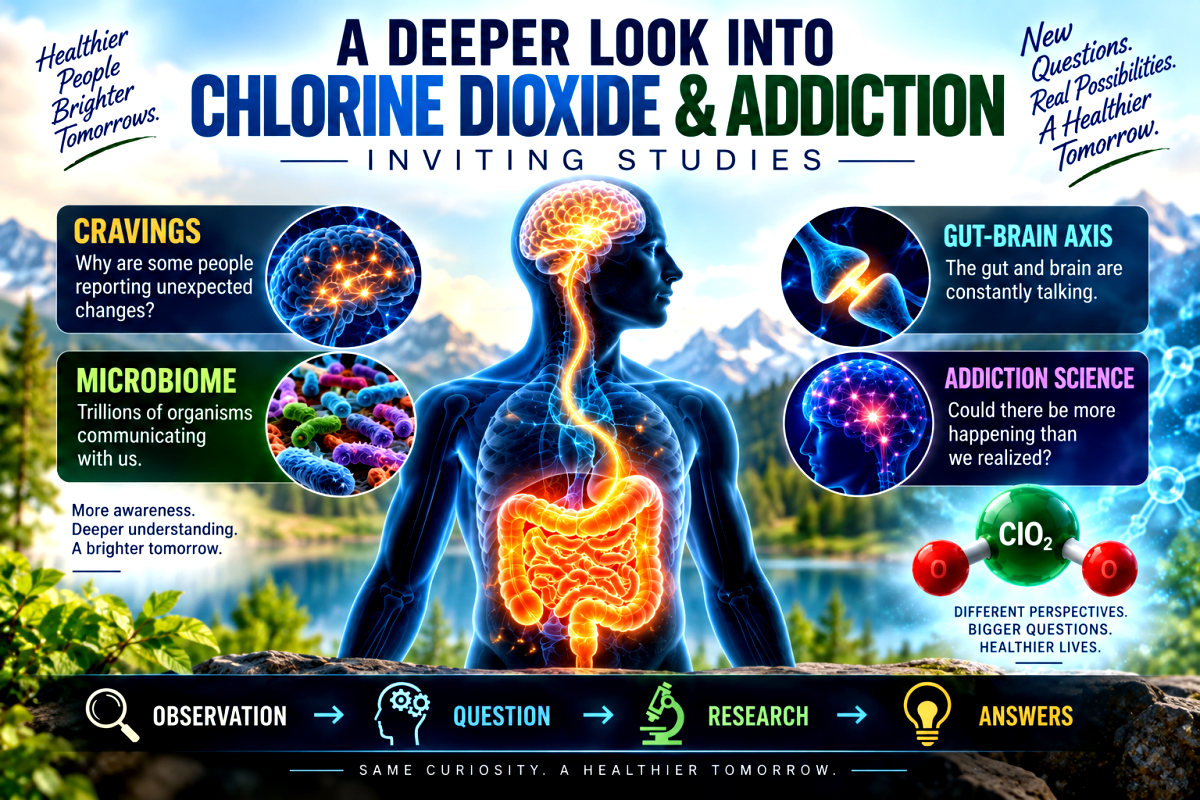
Some say alcohol suddenly became less appealing. Others describe losing interest in marijuana, prescription drugs, illicit drugs, binge eating, or compulsive behaviors. Still others report that patterns they had struggled to control for years somehow became easier to resist.
These are anecdotal reports. They do not prove that chlorine dioxide treats addiction. But when similar stories appear repeatedly, they raise an interesting question: Why?
Addiction Is More Than Willpower
Modern addiction science has moved far beyond the old idea that addiction is simply a failure of discipline.
Substance use disorders involve complex interactions between:
-
- reward circuitry
- stress hormones
- genetics
- trauma
- environment
- learning
- metabolism
- inflammation
- sleep
- mental health
- social conditions
And increasingly, researchers are adding another player to that list: the gut microbiome.
The Gut and Brain Are Constantly Talking
The digestive system contains trillions of microorganisms. These organisms help produce and modify chemicals that influence the rest of the body.
Some affect:
-
- inflammation
- immune function
- stress response
- neurotransmitter activity
- appetite
- mood
- reward behavior
Researchers call this communication network the gut-brain axis.
Recent scientific reviews suggest that substance use can alter the microbiome, and those changes may in turn influence craving, reward sensitivity, and relapse vulnerability. Alcohol appears especially capable of disrupting microbial balance and intestinal barrier function, but changes have also been reported with opioids, stimulants, and cannabis.
That does not mean gut bacteria “cause addiction.” It means addiction may involve more biological systems than we once realized.
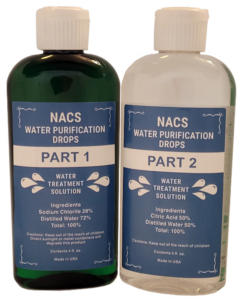
Where Chlorine Dioxide Enters the Question
Chlorine dioxide is an oxidizing antimicrobial agent. Its ability to disrupt microorganisms is well established in water treatment and disinfection.
So, when people using chlorine dioxide begin reporting unexpected changes in cravings or compulsive behavior, one hypothesis naturally presents itself:
We already know that changing the gut microbiome can alter addictive behavior. Could chlorine dioxide be changing that same gut-brain system in some of the people reporting these unexpected effects?
At present, we do not know.
There are no good clinical trials showing that chlorine dioxide treats alcohol use disorder, drug dependence, eating disorders, or behavioral addictions. But the question itself is biologically interesting.
Could Inflammation Be Part of the Story?
Substance use disorders are also associated with changes in immune and inflammatory signaling. The gut microbiome can influence those pathways.
Microbial imbalance may increase intestinal permeability, allowing inflammatory molecules to enter circulation and affect the nervous system. Recent reviews describe this as one possible way the microbiome may influence addiction biology.
Could an intervention that changes microbial activity also change inflammatory signaling? Possibly.
Would chlorine dioxide do so in a safe and beneficial way? That has not been established. But again, it is a testable question.
What About Food Addiction and Eating Disorders?
Food-related compulsions may deserve their own category. Binge eating, bulimia, anorexia, and other eating disorders are not simply “addictions,” and they have complex psychological, metabolic, and medical dimensions.
Still, appetite and eating behavior are influenced by:
-
- gut hormones
- microbial metabolites
- reward pathways
- stress
- inflammation
- blood sugar regulation
So, reports of sudden changes in bingeing or food cravings are particularly interesting from a gut-brain perspective.
They are not proof of a treatment effect. But they fit the larger pattern researchers are beginning to investigate.
What About Sex Addiction and Behavioral Compulsions?
This is where the hypothesis becomes even more challenging.
Sex addiction, gambling, compulsive internet use, and similar behaviors do not involve ingesting a substance. Yet they still engage the brain’s reward circuitry.
If people report changes in these behaviors after chlorine dioxide use, then a purely antimicrobial explanation becomes less satisfying.
That might suggest something broader involving:
-
- stress signaling
- dopamine-related pathways
- inflammation
- gut-derived metabolites
- expectancy effects
- changes in overall physical state
Or it may simply reflect coincidence, lifestyle changes, or placebo effects. We do not know.
The Placebo Question Matters Too
Whenever people expect an intervention to help, expectation itself can influence symptoms and behavior. That doesn’t make the experience fake.
Placebo and expectancy effects can alter:
-
- pain
- anxiety
- motivation
- perceived craving
- mood
- sleep
- stress response
Someone beginning a health program may also simultaneously change diet, alcohol intake, supplements, exercise, sleep, or social routines. Any of those changes could affect addictive behavior.
So, the presence of improvement doesn’t tell us what caused it.
What Would a Real Study Look Like?
This is actually a fascinating research design problem.
Researchers could recruit people with a specific condition, say alcohol use disorder, and measure:
-
- craving scores
- alcohol consumption
- relapse rates
- mood
- sleep
- inflammatory markers
- microbiome composition
- microbial metabolites
- liver function
- adverse effects
Then compare outcomes between carefully controlled groups.
If the chlorine dioxide group showed a consistent change, researchers could ask:
-
- Did the microbiome change first?
- Did inflammatory markers change?
- Did cravings fall before behavior changed?
- Was the effect temporary or persistent?
- Did different addictions respond differently?
That would begin turning anecdotes into data.
The Important Thing Is Not to Overstate the Pattern
The reports being described may represent something real. Or they may represent multiple unrelated phenomena that happen to look similar. That’s why this subject is so compelling. It is also why it deserves restraint.
There is currently no established evidence that chlorine dioxide treats addiction, eating disorders, or behavioral compulsions.
And chlorine dioxide is not harmless simply because it is inexpensive or familiar in water treatment. Dose, concentration, duration, and route of exposure all influence risk.
But the Pattern Is Worth a Question
Science often begins with someone noticing something unexpected. Not proving it. Not marketing it. Just noticing.
If people using chlorine dioxide for unrelated reasons repeatedly report sudden changes in craving, dependence, or compulsive behavior, there is nothing unscientific about asking:
What changed?
-
- Was it the microbiome?
- Inflammation?
- Stress chemistry?
- Reward signaling?
- Expectation?
- Lifestyle changes?
- Or something nobody has identified yet?
We don’t have the answer. But increasingly, addiction science is showing that the brain does not operate in isolation. The gut, immune system, metabolism, nervous system, and microbial environment all communicate continuously.
That makes the chlorine dioxide reports difficult to explain. But not impossible to investigate. And perhaps that’s exactly where this subject belongs right now:
Not as a treatment claim.
As a question worth studying.
Frequently Asked Questions About Chlorine Dioxide, Addiction & the Microbiome
Is there scientific evidence that chlorine dioxide treats addiction?
No. At present, there are no good controlled clinical trials establishing chlorine dioxide as a treatment for alcohol use disorder, drug dependence, eating disorders, sex addiction, or other behavioral compulsions.
What prompted this discussion are anecdotal reports from people who say their cravings or compulsive behaviors unexpectedly changed while using chlorine dioxide for unrelated purposes. Such reports can generate hypotheses, but they cannot establish cause and effect.
The interesting question is whether these observations could be connected to biological systems already being investigated in addiction research—particularly the gut microbiome and gut-brain axis.
What does the gut microbiome have to do with addiction?
Potentially quite a lot. The gut contains an enormous community of microorganisms that interact with the immune, metabolic, endocrine, and nervous systems. Gut microbes also produce metabolites capable of influencing biological signaling.
Researchers increasingly describe relationships among the microbiome, inflammation, stress responses, neurotransmission, reward sensitivity, and neuroplasticity.
Studies have reported microbiome alterations associated with alcohol, opioids, stimulants, cannabis, and other substances.
This doesn’t mean gut bacteria are the cause of addiction. Addiction involves genetics, environment, learning, trauma, reward circuitry, mental health, social circumstances, and many other factors. But it increasingly appears that the gut may participate in the conversation.
What is the gut-brain axis?
The gut-brain axis is the two-way communication network connecting the gastrointestinal system and brain. Communication can occur through the nervous system—including the vagus nerve—as well as immune signaling, hormones, microbial metabolites, and other biochemical pathways.
This means events occurring in the intestinal environment can potentially influence processes occurring in the brain—and the brain can influence the gut in return.
That makes addiction biology considerably more interesting than a simple “brain versus willpower” model.
Can changing gut bacteria actually affect addictive behavior?
There is preliminary evidence suggesting that it can. Animal experiments have found that altering gut microbial communities can influence alcohol-related and drug-related behaviors. Researchers are investigating connections with craving, withdrawal, stress responses, reward sensitivity, and relapse.
Human research remains much less developed. But one particularly intriguing area involves fecal microbiota transplantation, or FMT.
What could fecal transplants possibly have to do with alcohol addiction?
More than most people would expect. Fecal microbiota transplantation transfers a carefully screened preparation of intestinal microorganisms from a donor into another person’s gastrointestinal system.
A small randomized, double-blind clinical trial involving men with alcohol-use disorder and cirrhosis compared FMT with placebo.
Researchers reported that the FMT group experienced a greater reduction in alcohol craving over the initial follow-up period. They also observed changes in microbiome composition and other biological measures.
This was a small early-stage study, not proof that FMT cures alcoholism. But conceptually, it is remarkable.
Researchers deliberately changed the intestinal microbial ecosystem—and subsequently measured changes involving alcohol craving.
That tells us something important:
The possibility that microbiome manipulation can influence addictive behavior is a legitimate scientific question.
Does that mean an unhealthy microbiome causes addiction? No.
The relationship could work in several directions. Substance use can alter the microbiome. Diet and lifestyle associated with addiction can alter it. The changed microbiome might then influence inflammation, stress, mood, or reward signaling. All of these processes could potentially reinforce one another.
Researchers sometimes describe this as a bidirectional relationship rather than a simple chain of cause and effect.
What about eating disorders?
This is another developing research area. Researchers have identified differences in gut microbial composition among some people with anorexia nervosa and other eating disorders, although determining cause and effect remains difficult.
FMT has even entered early experimental research involving anorexia nervosa. These studies are preliminary and certainly don’t establish FMT as an eating-disorder treatment.
But they reinforce the larger point:
Scientists are actively investigating whether changing the microbiome can influence metabolism, appetite, mood, and eating behavior.
What about behavioral addictions that don’t involve consuming anything?
This may be one of the most interesting questions of all. Alcohol, marijuana, opioids, and food enter the body. Gambling, pornography, compulsive sexual behavior, gaming, shopping, and other behavioral compulsions do not. Yet all can interact with reward, motivation, stress, learning, and reinforcement systems in the brain.
Therefore, if credible observations eventually showed that microbiome changes affected both substance-related and behavioral compulsions, researchers would need to look beyond simply changing how a particular substance is metabolized.
They might investigate broader effects involving inflammation, stress signaling, microbial metabolites, neurotransmission, or reward circuitry. At present, that remains speculative.
Could parasites be involved in addiction?
Certain parasites can alter host behavior, particularly in animal models, and researchers have investigated associations between some infections and psychiatric or behavioral outcomes.
But there is currently no good evidence that ordinary alcohol, drug, food, or behavioral addictions are generally caused by hidden parasites.
That hypothesis shouldn’t be presented as established fact. It remains an interesting but considerably more speculative branch of the larger microbiome story.
Where does chlorine dioxide enter this picture?
This is the unanswered question. Chlorine dioxide has well-established antimicrobial properties. It can affect microorganisms through oxidative chemistry.
Meanwhile, addiction research increasingly suggests that intestinal microorganisms can influence biological pathways related to craving and behavior.
Those two facts create a hypothesis, not a conclusion:
Could chlorine dioxide alter some components of the intestinal microbial ecosystem in a way that influences gut-brain signaling, inflammation, craving, or compulsive behavior?
We don’t presently know.
More importantly, we don’t yet know whether any microbiome alteration produced by chlorine dioxide would be transient or irrelevant.
That’s precisely why research would be useful.
Couldn’t the reported reduction in cravings simply be placebo?
Absolutely. Expectancy, motivation, participation in a new health regimen, changes in diet, improved sleep, reduced substance exposure, nausea or temporary aversion, and many other factors could produce apparent improvements.
Anecdotes cannot reliably separate those possibilities. That doesn’t make the reports worthless. It tells us what kind of study is needed.
What would researchers need to study?
A particularly informative first study wouldn’t need to begin by claiming chlorine dioxide treats addiction.
Researchers could simply recruit participants already intending to use it and prospectively measure what happens. They could monitor craving, substance consumption, compulsive behavior, microbiome composition, microbial metabolites, inflammatory markers, sleep, mood, diet, adverse effects, and relapse.
If nothing changes, that’s useful information. If cravings change but the microbiome doesn’t, that’s useful too.
And if measurable microbiome changes consistently occur before changes in craving or behavior, researchers would suddenly have a considerably more interesting lead.
So what can we conclude today?
Something much narrower, and more interesting, than “chlorine dioxide treats addiction.”
We can conclude that:
- Addiction and the microbiome are scientifically connected areas of investigation.
- Manipulating the microbiome has produced addiction-related behavioral changes in some experimental research.
- Preliminary human FMT research has reported changes in alcohol craving.
- People are independently reporting unexpected changes in cravings while using chlorine dioxide.
But the final connection—
chlorine dioxide → microbiome change → altered gut-brain signaling → reduced addictive behavior
— has not been demonstrated.
That missing arrow is precisely what makes the subject worth investigating.
Selected Research & References
- Fecal Microbiota Transplantation and Alcohol Craving
Bajaj JS, et al. “A Randomized Clinical Trial of Fecal Microbiota Transplant for Alcohol Use Disorder.” Hepatology. 2021;73(5):1688–1700. DOI: 10.1002/hep.31496.
This is probably the most compelling reference for our article. Twenty men with alcohol-use disorder and cirrhosis participated in a randomized, double-blind trial. At day 15, reduced craving was reported in 90% of the FMT group versus 30% receiving placebo. Researchers also found lower urinary alcohol biomarkers and changes in cognition, inflammation, microbial diversity, and microbial metabolites. The study was small and involved a specialized patient population, so it should be considered preliminary rather than proof that FMT treats alcohol addiction.
PubMed: Randomized FMT Trial for Alcohol Use Disorder
- The Gut Microbiome and Substance Use Disorder
Meckel KR, Kiraly DD. “The Gut Microbiome and Substance Use Disorder.” Frontiers in Neuroscience. 2021;15:725500. DOI: 10.3389/fnins.2021.725500.
An excellent foundational review. It examines evidence connecting the gut microbiome with cocaine, opioids, alcohol, nicotine and other substance-use disorders and discusses possible metabolic, immune, neurological and epigenetic mechanisms.
PubMed: The Gut Microbiome and Substance Use Disorder
- A 2026 Systematic Review of Addiction Biology
“The Gut Microbiota in Addiction Biology: A Systematic Review of Substance-Induced Dysbiosis and Gut-Brain Axis Alterations.” 2026. PMID: 42506336.
This is particularly useful because it systematically reviewed 60 studies published from 2019–2025 involving alcohol, nicotine, opioids, cocaine and methamphetamine.
The authors found recurring evidence of substance-associated dysbiosis, including loss of some beneficial short-chain-fatty-acid-producing organisms, increases in some opportunistic organisms, intestinal-barrier disruption and systemic inflammatory signaling. Importantly for our hypothesis, the review also found preclinical FMT and germ-free-model evidence suggesting microbial changes can affect reward sensitivity and neuroplasticity through the gut-brain axis. PubMed: Gut Microbiota in Addiction Biology Systematic Review
- Human Studies Across Alcohol, Cannabis, Opioids, and Stimulants
Barkus A, et al. “Exploring the Gut and Oral Microbiomes in Psychoactive Substance Use: A Scoping Review of Clinical Studies.” Journal of Neurochemistry. 2025;169(7):e70165. DOI: 10.1111/jnc.70165.
This review examined 75 clinical studies involving alcohol, stimulants, cannabis and opioids. The researchers found recurring differences between microbial communities of people using these substances and controls, although results for individual organisms were inconsistent. Some evidence also suggested partial microbiome recovery following extended abstinence. PubMed: Psychoactive Substance Use and the Microbiome
- Microbial Metabolites May Be Part of the Communication System
Koperska M, Kiraly DD. “Microbiome-derived metabolites in substance use disorders: Mechanisms and implications.” Annals of the New York Academy of Sciences. 2025;1551(1):93–114. DOI: 10.1111/nyas.15416.
This review gets closer to the fascinating “How could bacteria in my gut possibly affect what I want?” question.
It discusses short-chain fatty acids, tryptophan derivatives, neurotransmitters, bile acids and immune molecules produced or influenced by gut microorganisms. These substances can participate in communication between the gastrointestinal system and brain, potentially influencing behavioral responses to drugs. PubMed: Microbiome-Derived Metabolites in Substance Use Disorders
- Alcohol Use Disorder and the Gut-Brain Axis
Leclercq S, de Timary P. “Role of the Microbiome and the Gut-Brain Axis in Alcohol Use Disorder: Potential Implication for Treatment Development.” Current Topics in Behavioral Neurosciences. 2025;72:737–754. DOI: 10.1007/7854_2024_478.
The authors review evidence of altered bacterial, viral and fungal communities among people with alcohol-use disorder and explain communication pathways involving microbial metabolites, inflammatory cytokines and the vagus nerve. PubMed: Microbiome and Gut-Brain Axis in Alcohol Use Disorder
- Alcohol, Dysbiosis, Inflammation, and Recovery
Shukla S, Hsu CL. “Alcohol Use Disorder and the Gut-Brain Axis: A Narrative Review of the Role of Gut Microbiota and Implications for Treatment.” Microorganisms. 2025;13(1):67. DOI: 10.3390/microorganisms13010067.
This review examines both directions of the relationship: alcohol changes the intestinal environment, while microbiome and gut-brain changes may participate in maintaining alcohol-use disorder. PubMed: Alcohol Use Disorder and the Gut-Brain Axis
- A Broader Look at Gut Microbiome, Epigenetics, and Addiction
Sahebi K, et al. “The interplay between gut microbiome, epigenetics, and substance use disorders: from molecular to clinical perspectives.” European Journal of Pharmacology. 2025;998:177630. DOI: 10.1016/j.ejphar.2025.177630.
This recent review considers how microbial metabolites, cytokines and neurotransmitter-related pathways could influence addiction biology. It also discusses microbiome-directed interventions—including probiotics, prebiotics, antibiotics and FMT—while emphasizing that mechanisms and clinical applications remain uncertain. PubMed: Gut Microbiome, Epigenetics and Substance Use Disorders
What these studies do—and do not—tell us: The research above does not demonstrate that chlorine dioxide treats addiction. It establishes something narrower but important: the intestinal microbiome and gut-brain axis are increasingly recognized as participants in substance-use biology, and experimental manipulation of the microbiome has influenced craving and addiction-related behavior in some studies. Whether chlorine dioxide changes this system in a way that could explain the anecdotal reports discussed in this article remains unknown. That missing connection is the reason further research is being invited.
Educational Notice
This article is for informational purposes only. Chlorine dioxide has not been established as a treatment for addiction, substance use disorders, eating disorders, or behavioral addictions. It should not replace evidence-based addiction treatment, withdrawal management, psychotherapy, medication-assisted treatment, or emergency medical care. Chlorine dioxide is a reactive oxidizing chemical, and inappropriate exposure can cause harm. Anyone struggling with addiction or an eating disorder should seek qualified professional care.
Leave a Reply