From early human-exposure studies and antiviral chemistry to water-treatment discoveries and unconventional cancer research, a closer look at the publications behind the controversy.
For decades, chlorine dioxide has occupied an unusual place in scientific and public conversation. In water treatment, it is a familiar disinfectant. In industrial sanitation, its oxidizing properties are well documented. In microbiology, researchers have examined how it interacts with viruses, bacteria, proteins, and other biological materials. Yet introduce chlorine dioxide into a conversation about human health, and the discussion can change dramatically.
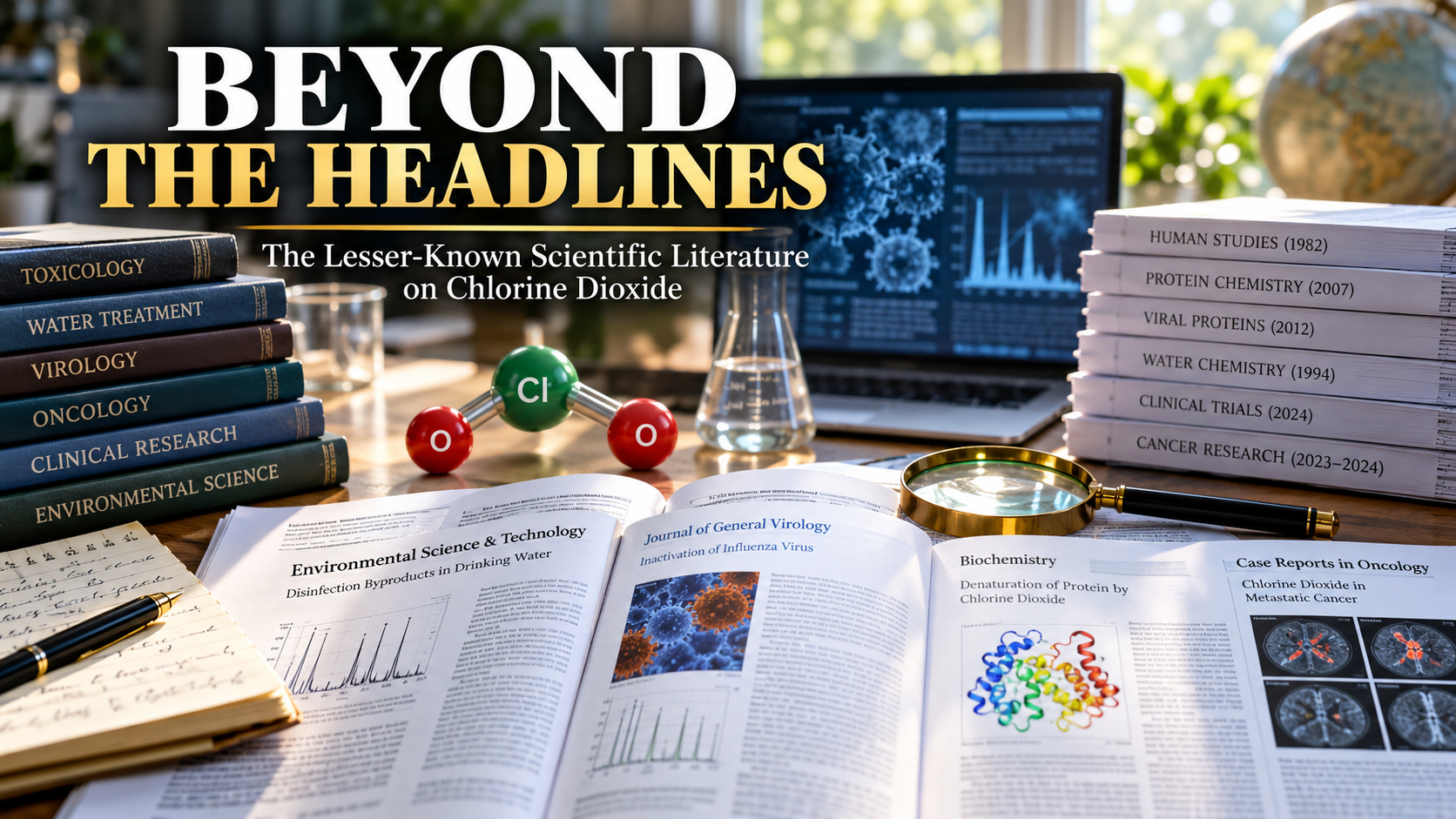
Some people associate chlorine dioxide immediately with regulatory warnings. Others remember the extraordinary claims made by alternative-health advocates. Still others describe personal experiences that changed their opinions about the substance.
Between these competing narratives lies a body of scientific literature that many readers have never encountered.
Some publications are decades old. Others are comparatively recent. Some describe established chemical processes, while others explore unconventional medical possibilities. Together, they reveal a more extensive and varied research history than the familiar headlines might suggest.
The most interesting question may not be whether chlorine dioxide belongs in one category or another. It may be: What have researchers actually investigated, and what did they discover?

1. The Early Human Studies: Chlorine Dioxide Was Investigated Decades Ago
One of the more surprising discoveries for people encountering chlorine dioxide research is that controlled human-exposure studies were conducted more than forty years ago. In 1982, J. R. Lubbers, S. Chauhan, and J. R. Bianchine published Controlled Clinical Evaluations of Chlorine Dioxide, Chlorite and Chlorate in Man in the journal Environmental Health Perspectives.
The investigators examined human exposure to chlorine dioxide and related drinking-water disinfectant substances. Their work included acute exposure assessments and repeated exposure over twelve weeks. The researchers reported no clinically significant adverse physiological effects under the particular conditions examined.
Additional publications from this research program appeared in 1984, including studies involving healthy adult male volunteers and a small group of individuals with glucose-6-phosphate dehydrogenase deficiency.
Why is this interesting? Because it shows that chlorine dioxide was not simply assumed to be harmless or harmful. Researchers investigated particular exposure conditions, collected physiological measurements, and published their observations.
The studies were concerned with drinking-water disinfection and exposure tolerance, not treatment of cancer, infections, or other diseases. Their findings therefore have a defined scope. Nevertheless, they remain part of the historical scientific record.
Research references: Lubbers, Chauhan, and Bianchine (1982); Lubbers and Bianchine (1984); Lubbers and colleagues (1984).
2. The Chemistry of Oxidation: What Chlorine Dioxide Actually Does
Chlorine dioxide is a strong oxidizing agent. Oxidation involves the transfer of electrons between chemical substances. In biological systems, oxidation can alter proteins, lipids, and other molecules, sometimes changing their structure or function.
This is central to chlorine dioxide’s antimicrobial activity. But oxidation is not one uniform biological event. Different oxidizing substances react with different targets at different rates. Environmental conditions, concentrations, exposure duration, and the surrounding chemical environment influence what happens.
A particularly revealing paper appeared in 2007. Norio Ogata published Denaturation of Protein by Chlorine Dioxide: Oxidative Modification of Tryptophan and Tyrosine Residues in the journal Biochemistry.
The research examined how chlorine dioxide modifies particular amino-acid residues in proteins. Tryptophan and tyrosine are components of many biological proteins. Changes to these residues can affect protein structure and function.
This work offered a molecular explanation for some of chlorine dioxide’s biological activity. Rather than describing the compound simply as something that kills microorganisms, the study explored the underlying chemical interactions.
That distinction becomes especially interesting when examining later research involving viruses and cancer cells.
Research reference: Ogata (2007).
3. A More Specific Discovery: Chlorine Dioxide and Viral Proteins
In 2012, Ogata published another paper, this time in the Journal of General Virology. Its title was unusually specific: Inactivation of Influenza Virus Haemagglutinin by Chlorine Dioxide: Oxidation of the Conserved Tryptophan 153 Residue in the Receptor-Binding Site.
The study investigated influenza hemagglutinin, a viral protein involved in attaching to host cells. The researchers identified oxidative modification of a particular tryptophan residue associated with the protein’s receptor-binding function.
The significance lies in the specificity of the mechanism. The paper did not merely report that chlorine dioxide could inactivate influenza virus under experimental conditions. It explored how a particular chemical interaction could interfere with an important viral function.
This helped connect chlorine dioxide’s antimicrobial properties with identifiable molecular targets. It also helps explain why some researchers subsequently became interested in broader biological applications of the compound.
An important distinction remains: chemically inactivating a virus in a laboratory or environmental setting is different from successfully treating a viral infection inside a person. Still, the molecular mechanism is an established subject of scientific investigation, not simply an alternative-health theory.
Research reference: Ogata (2012).
4. Drinking-Water Research Reveals Another Side of Chlorine Dioxide
The scientific literature also contains important discoveries that have little to do with viruses. In 1994, Susan D. Richardson and six colleagues published Multispectral Identification of Chlorine Dioxide Disinfection Byproducts in Drinking Water in Environmental Science & Technology.
Their investigation examined the chemical substances formed during chlorine dioxide treatment of drinking water. Using multiple analytical techniques, the researchers characterized organic disinfection byproducts.
This is important because water treatment involves more than eliminating microorganisms. Disinfectants interact with substances already present in water, sometimes transforming them into new compounds. Understanding those transformations helps water-treatment specialists evaluate treatment processes and water quality.
Chlorine dioxide also has applications involving dissolved metals. Iron and manganese can occur in water in soluble forms that are difficult to remove mechanically. Under suitable treatment conditions, oxidation can convert dissolved metals into less-soluble forms that can subsequently be separated by filtration or related processes.
Health Canada’s technical guidance on drinking-water iron treatment specifically identifies chlorine dioxide among the oxidants capable of converting dissolved iron into particulate forms.
Here, chlorine dioxide serves a purpose beyond microbial disinfection. It participates in a chemical transformation that helps a water-treatment system remove an unwanted substance.
The distinction is important: chlorine dioxide does not simply make metals disappear. Oxidation changes their chemical form, while a separate treatment step removes the resulting particles.
This is a useful example of the versatility of chlorine dioxide’s chemistry.
Research references: Richardson and colleagues (1994); Health Canada, Guidelines for Canadian Drinking Water Quality: Iron.
5. A Physician Examines the Chlorine Dioxide Controversy
In 2021, physician Mitchell Brent Liester published The Chlorine Dioxide Controversy: A Deadly Poison or a Cure for COVID-19? in the International Journal of Medicine and Medical Sciences. The article brought together several lines of literature, including chlorine dioxide chemistry, industrial applications, antiviral activity, human-exposure research, and early COVID-19 treatment claims.
Liester was particularly interested in how different formulations, concentrations, and applications had become entangled in public discussions. His review presented arguments favoring chlorine dioxide as a potential COVID-19 treatment.
Those conclusions were more favorable than the clinical evidence justified, and subsequent controlled mouthwash trials did not demonstrate the anticipated reductions in salivary SARS-CoV-2 levels.
Nevertheless, the review is historically interesting because it shows a physician examining the controversy through published literature rather than discussing chlorine dioxide solely as a political or cultural issue.
It also illustrates how researchers can examine overlapping bodies of evidence and reach conclusions that differ substantially from those of regulatory agencies or other scientists. The publication itself becomes part of the history of how chlorine dioxide was discussed during the pandemic.
Research reference: Liester (2021).
6. Clinical Research Moves Into the Mouthwash Setting
An especially useful development occurred in 2024, when researchers published controlled clinical investigations of chlorine dioxide-containing mouthwashes in people with COVID-19.
One multicenter study led by Daisuke Onozuka compared an on-demand aqueous chlorine dioxide mouthwash with cetylpyridinium chloride mouthwash and a placebo. The study enrolled 49 participants across its three groups. The chlorine dioxide mouthwash did not significantly reduce salivary SARS-CoV-2 viral titers compared with placebo at the measured time points.
Another randomized clinical trial, published in BMC Oral Health, similarly found no significant advantage for its chlorine dioxide mouthwash intervention in reducing measured salivary viral load.
Why include studies with disappointing results? Because they show how a specific hypothesis can move from chemical reasoning into clinical examination.
Researchers identified a plausible application, selected a measurable biological outcome, and compared the intervention with a control.
The results also reveal an important feature of biological systems: a substance’s demonstrated action against a microorganism under one set of conditions does not necessarily produce the same outcome in a different environment.
The oral cavity is a complicated setting, with saliva, proteins, microorganisms, and other interacting substances.
These clinical publications add a different kind of information to the chlorine dioxide story.
Research references: Onozuka and colleagues (2024); BMC Oral Health randomized trial (2024).
7. A Surprising Turn: Chlorine Dioxide Enters the Cancer Literature
Perhaps the most unexpected research direction involves oncology. In May 2023, Manuel Aparicio-Alonso, Laurent Schwartz, and Verónica Torres-Solórzano released a manuscript titled Chlorine Dioxide Solution in Metastatic Uncurable Cancer: Case Series.
The authors described six individuals with advanced cancers involving the breast, kidney, prostate, lymphatic system, uterus, and melanoma. They reported tumor responses associated with combinations of chlorine dioxide administration and other aspects of patient care.
Their proposed explanation centered on oxidative activity and the possibility that cancer cells’ altered redox balance could influence their response.
The manuscript is particularly notable because the authors reported clinical observations rather than merely proposing a chemical theory.
However, the original case series was a preprint, and its later revisions narrowed the reported cases. The initial six-case version should therefore be identified precisely rather than treated as interchangeable with subsequent versions.
The publication represents an identifiable attempt to discuss chlorine dioxide within an oncology context.
A related 2024 case report by Aparicio-Alonso and Torres-Solórzano described the compassionate application of a chlorine dioxide-based solution in a patient with metastatic prostate cancer. This provides another documented example of investigators pursuing the same general idea.
These reports should not be interpreted as evidence that ingesting or injecting chlorine dioxide is an established cancer treatment. Such administration can cause serious injury. But as part of the history of unconventional oncology research, the publications are noteworthy.
Research references: Aparicio-Alonso, Schwartz, and Torres-Solórzano (2023); Aparicio-Alonso and Torres-Solórzano (2024).
8. A Different Cancer Approach: Delivering Chlorine Dioxide Directly Into Tumors
Another research group approached the oncology question from a different direction. In a preprint originally posted in 2023 and subsequently revised in 2024, Xuewu Liu and colleagues presented Intratumoral Delivery of Chlorine Dioxide Exploits Its ROS-like Properties: A Novel Paradigm for Effective Cancer Therapy.
Instead of examining systemic administration, the authors explored the concept of delivering chlorine dioxide directly into tumor tissue. Their proposed strategy involved several related effects.
First, chlorine dioxide’s oxidative activity might contribute to localized tumor destruction.
Second, the authors proposed that treatment could damage tumor blood vessels.
Third, they suggested that localized tumor injury might stimulate an antitumor immune response.
One statement in the abstract is especially revealing:
The authors advocate direct tumor treatment with the aim of destroying cancerous tissue while minimizing injury to healthy tissues.
That wording is significant because it identifies selective local treatment as a central objective. It does not, by itself, establish that such selectivity has been demonstrated safely in human patients. But the research direction is distinctive.
The authors are not discussing chlorine dioxide simply as a general antimicrobial agent. They are considering whether its oxidative properties might be harnessed for a specific therapeutic intervention.
The manuscript also discloses commercial interests and patent applications relating to chlorine dioxide cancer treatment.
That detail adds another dimension to the research history: at least some investigators have considered chlorine dioxide-related therapeutic applications sufficiently promising to pursue intellectual-property protection.
Research reference: Liu and colleagues (2023–2024), bioRxiv preprint.
9. Connecting the Dots: Three Recurring Scientific Themes
Looking across these publications, several themes begin to emerge.
Oxidation is the common chemical foundation
Whether researchers are examining water treatment, viral proteins, dissolved metals, or tumor tissue, oxidation repeatedly appears as the underlying chemical process.
The outcomes differ because the targets and experimental conditions differ.
Biological context changes the outcome
Chlorine dioxide’s effects on a purified protein, a microorganism in water, a mouthwash mixture, and living human tissue cannot be assumed to be identical.
Each environment introduces different chemical and biological interactions.
This helps explain why one line of research may produce a promising laboratory observation while another produces a disappointing clinical result.
Researchers are asking different questions about the same compound
The early human studies examined exposure tolerance.
The water-treatment studies examined disinfection and chemical transformations.
The molecular studies investigated interactions with biological proteins.
The COVID-19 studies examined antiviral hypotheses in human settings.
The oncology publications explored unconventional applications involving tumor biology.
These are not interchangeable findings, but they are related chapters in a broader scientific history.
Together, they show how a familiar chemical substance can attract attention across multiple fields.
10. Beyond the Familiar Public Narratives
One of the challenges in discussing chlorine dioxide is that the public conversation has often been dominated by its most controversial claims. That can obscure legitimate scientific work involving its established properties and specialized applications. The opposite mistake is also possible: treating every laboratory observation, case report, or exploratory preprint as proof of a medical breakthrough.
Neither approach does justice to the literature.
The more interesting story is the diversity of questions investigators have pursued.
A researcher studying viral proteins may have little connection to someone studying drinking-water byproducts.
An oncologist describing a compassionate-use case may be asking entirely different questions from an engineer evaluating iron oxidation.
Yet their work intersects through the chemistry of the same compound. That is what makes the literature worth exploring.
It is not one unified body of evidence supporting a single conclusion. It is a collection of investigations revealing different properties, applications, possibilities, and limitations. And for readers who have encountered chlorine dioxide only through headlines, discovering that broader history may be genuinely surprising.

A Scientific Story With More Than One Chapter
Chlorine dioxide has been studied for generations. Its disinfectant properties are well established. Its chemical interactions with proteins and microorganisms have been investigated at the molecular level. Its role in water treatment extends beyond microbial control into other chemical transformations.
Researchers have examined controlled human exposures, tested particular antiviral applications, and explored unconventional ideas involving cancer biology. Some findings have supported practical applications. Others have challenged expectations. Still others remain preliminary observations or proposals.
What emerges is not a simple story of vindication or rejection. It is a picture of a compound whose chemistry has attracted attention across several scientific disciplines.
Perhaps the most useful discovery is that the familiar public controversy represents only one part of the history.
Beyond the headlines are decades of experiments, named researchers, published observations, and questions that have taken the science in unexpected directions.
Sometimes the most surprising thing about a familiar subject is discovering how much of its story has been happening outside the spotlight.
FAQ
Q: Has chlorine dioxide been scientifically studied?
Yes. Chlorine dioxide has been investigated for decades in drinking-water treatment, antimicrobial chemistry, environmental applications, controlled human-exposure studies, and selected experimental medical contexts.
Q: What are the earliest human studies involving chlorine dioxide?
Controlled studies published in the early 1980s by Lubbers and colleagues examined exposure to chlorine dioxide and related disinfectant substances under specific conditions, primarily in the context of drinking-water safety.
Q: What does scientific research reveal about chlorine dioxide’s antiviral properties?
Laboratory studies have identified chlorine dioxide’s ability to oxidize certain viral proteins. Research by Norio Ogata, for example, examined oxidative changes to influenza hemagglutinin that interfere with viral function.
Q: Has chlorine dioxide been investigated for cancer treatment?
Yes. A 2023 case-series preprint described cancer patients receiving chlorine dioxide preparations, while a separate 2023–2024 preprint explored direct delivery into tumors. These publications describe preliminary investigations, not established cancer treatments.
Q: What is the connection between chlorine dioxide and reactive oxygen species?
Chlorine dioxide is an oxidizing agent, and some researchers have compared aspects of its chemical activity with reactive oxygen species involved in biological processes. The comparison does not mean the substances behave identically in the body.
Q: Can chlorine dioxide help remove metals from drinking water?
Under suitable conditions, chlorine dioxide can oxidize dissolved iron and manganese into forms that may be removed by filtration or other water-treatment processes.
Q: Are all chlorine dioxide research papers peer-reviewed?
No. The literature includes peer-reviewed experimental studies, narrative reviews, clinical trials, case reports, and preprints.
References
| Year | Publication | Link |
| 1982 | Lubbers et al. — Controlled Clinical Evaluations of Chlorine Dioxide, Chlorite and Chlorate in Man | Study |
| 1982 | Couri et al. — Toxicological Effects of Chlorine Dioxide, Chlorite and Chlorate | Review |
| 1984 | Lubbers & Bianchine — Effects of the Acute Rising Dose Administration… | Study |
| 1984 | Lubbers et al. — Effects of Chronic Administration of Chlorite to G6PD-Deficient Volunteers | Study |
| 1994 | Richardson et al. — Multispectral Identification of Chlorine Dioxide Disinfection Byproducts in Drinking Water | Study |
| 2007 | Ogata — Denaturation of Protein by Chlorine Dioxide | Study |
| 2012 | Ogata — Inactivation of Influenza Virus Haemagglutinin by Chlorine Dioxide | Study |
| 2021 | Liester — The Chlorine Dioxide Controversy | Review |
| 2023 | Aparicio-Alonso et al. — Chlorine Dioxide Solution in Metastatic Uncurable Cancer | Preprint |
| 2023–24 | Liu et al. — Intratumoral Delivery of Chlorine Dioxide Exploits Its ROS-like Properties | Preprint |
| 2024 | Aparicio-Alonso & Torres-Solórzano — Compassionate Application… in Metastatic Prostate Cancer | Case report |
| 2024 | Onozuka et al. — On-Demand Aqueous Chlorine Dioxide Mouthwash and SARS-CoV-2 Viral Titer | Clinical trial |
| 2024 | Oral Mouthwashes for Adults With COVID-19 and Salivary Viral Load | Clinical trial |
| 2025 | Health Canada — Guidelines for Canadian Drinking Water Quality: Iron | Technical guidance |
Disclaimer: This article is an informational review of scientific publications and research history. Established uses of chlorine dioxide in controlled disinfection and water treatment do not establish its safety or effectiveness as a medical treatment. Oral, rectal, or intravenous administration of chlorine dioxide preparations can cause serious harm. Experimental findings, preprints, and individual case reports should not be interpreted as clinical treatment recommendations.
Leave a Reply