Back pain doesn’t sound like something that should have much to do with chlorine dioxide. A herniated disc is a herniated disc. Spinal stenosis is narrowing of the spinal canal. Osteoarthritis involves deterioration within joints. Sciatica involves an irritated or compressed nerve. Degenerative disc disease involves changes within the discs separating the vertebrae. Spondyloarthritis is inflammatory disease. These aren’t even the same disorder.
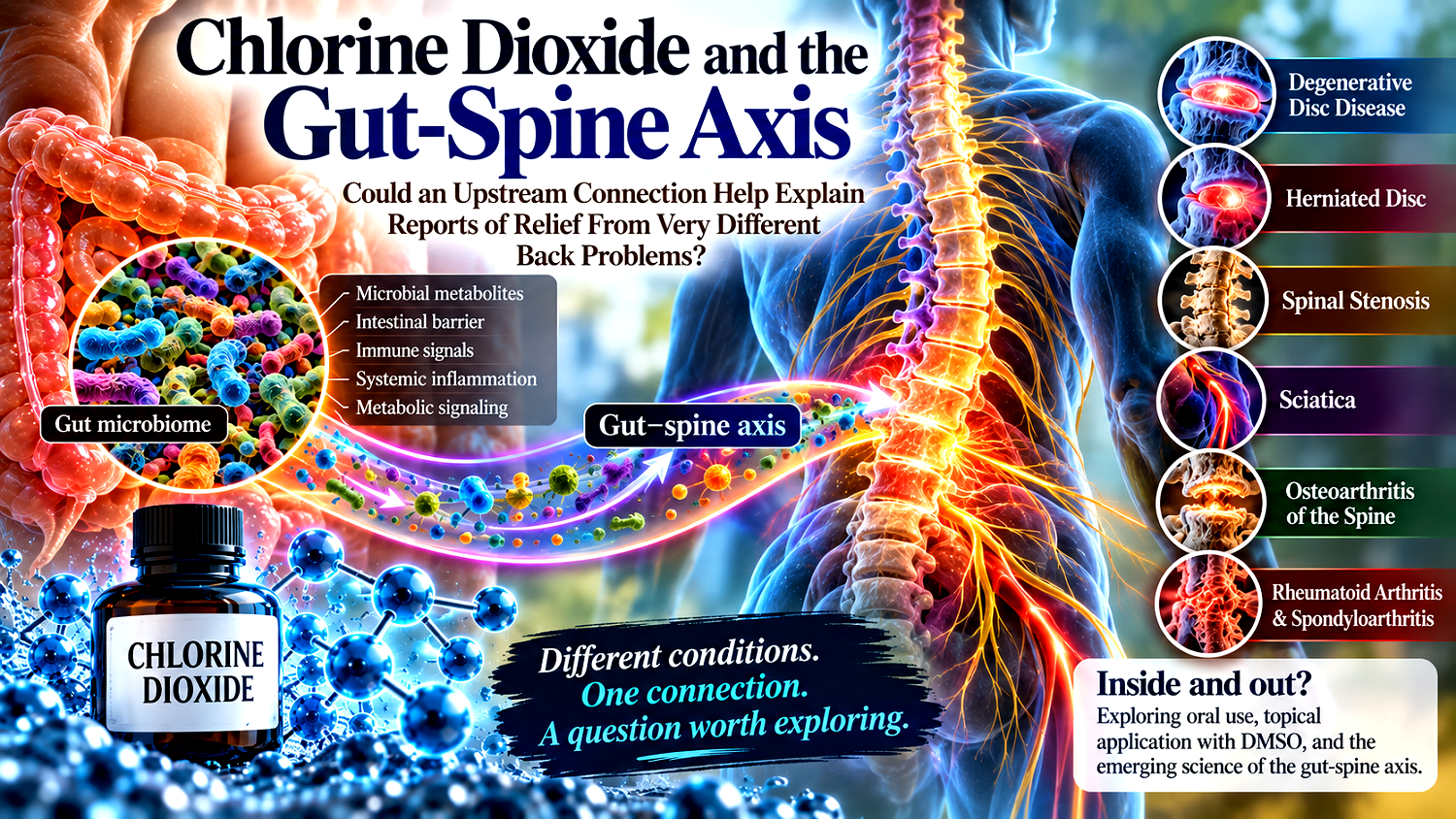
Yet Herb Roi Richards collected reports from people who attributed remarkable improvements in a surprisingly broad assortment of back and spinal problems to chlorine dioxide, sometimes using it orally alone.
Herb generally believed people could do even better by approaching the problem from both sides. His protocols frequently combined internal use with topical application of chlorine dioxide mixed with DMSO, applied “on and well around” the affected area.
For years, it would have been easy to look at a list like this and ask: How could an oxidizing antimicrobial possibly fix all these different things?
That’s still a perfectly reasonable question. But today we can ask a better one. Because scientists studying spinal degeneration have recently given a name to something called: The Gut-Spine Axis And suddenly this investigation gets considerably more interesting.
Maybe We’ve Been Asking Chlorine Dioxide to Do the Impossible
Suppose ten people report improvement after using the same substance.
- One has degenerative disc disease.
- Another has a herniated disc.
- Another has osteoarthritis of the spine.
- Another has sciatica.
- Another has spinal stenosis.
- Another has inflammatory spondyloarthritis.
At first glance, there are two possibilities. Either chlorine dioxide somehow knows how to repair discs, cartilage, joints, nerves, ligaments and bone – which would be an extraordinary claim – or perhaps some of these conditions eventually intersect with shared biological processes that influence symptoms and disease progression.
That second possibility gives us somewhere useful to look. And researchers are already looking there.
Scientists Are Actually Calling It the “Gut-Spine Axis”
In 2023, researchers from several Japanese medical institutions published a review proposing the term gut-spine axis. They weren’t discussing chlorine dioxide. They were investigating the relationship between intestinal microorganisms and spinal degenerative diseases.
Their definition of spinal degeneration included problems involving numerous spinal structures:
bone — osteoporosis
joints — facet osteoarthritis
discs — intervertebral disc degeneration
ligaments — lumbar spinal canal stenosis
muscle — spinal sarcopenia
The researchers proposed that gut microorganisms could potentially influence the metabolic, immune, and endocrine environments affecting these structures. Frontiers
That’s quite a collection of supposedly unrelated back problems connected by one emerging research concept. It doesn’t prove that intestinal bacteria cause these diseases. And it certainly doesn’t prove that chlorine dioxide treats them. But it gives us our first important clue.
A Disc Isn’t Just a Shock Absorber
It’s tempting to think of the spine entirely as machinery. Vertebra. Disc. Vertebra. Disc. Something wears out, gets squashed or moves somewhere it shouldn’t, and the machinery hurts.
Mechanical forces absolutely matter. But an intervertebral disc is living biological tissue.
Disc degeneration involves cells, extracellular matrix, inflammatory signaling, nutrient availability, metabolism, and other biological processes in addition to mechanical wear.
And researchers have increasingly investigated whether intestinal biology might influence some of those processes.
A 2026 scoping review of the gut-disc axis in lumbar disc herniation examined both preclinical and clinical evidence and concluded that microbiome involvement is biologically plausible through systemic and local mechanisms involving immune, inflammatory and metabolic pathways. Importantly, the authors also emphasized that the evidence remains preliminary and causality has not been established. PubMed
That’s exactly the kind of science we want for this discussion.
Not: “The gut causes bad discs.” But: “There may be communication between biological processes in the gut and biological processes affecting the disc.”
That’s a very different proposition.
What Could the Gut Possibly Have to Do With Your Back?
Think upstream. The gastrointestinal tract contains an enormous microbial ecosystem.
Those organisms participate in producing metabolites and interacting with the immune system. The intestinal barrier regulates what crosses from the intestinal environment into circulation.
When that ecosystem changes, researchers are investigating downstream consequences involving:
microbial metabolites
intestinal-barrier integrity
immune signaling
systemic inflammation
metabolic signaling
Those effects don’t necessarily remain in the intestine. They circulate.
So, our pathway begins looking something like this:
GUT
↓
microbiome / microbial activity
↓
intestinal barrier
↓
microbial metabolites + immune signals
↓
systemic metabolic and inflammatory environment
↓
SPINAL TISSUES
disc • joint • bone • ligament • muscle • nerve
↓
inflammation • degeneration • nerve irritation • pain
Again, chlorine dioxide isn’t in that chain yet. We’re establishing the highway before asking whether chlorine dioxide ever travels on it.
Spinal Stenosis Provides a Fascinating Example
Spinal stenosis seems especially resistant to an upstream explanation. If the spinal canal has physically narrowed, how could changing something in the gut possibly widen it?
It probably wouldn’t. And that’s where we need to distinguish anatomy from symptoms.
Researchers nevertheless have found an intriguing association between intestinal microorganisms and spinal stenosis.
A 2024 two-sample Mendelian-randomization study used gut-microbiota genetic data from 13,266 people and spinal-stenosis data involving 9,169 cases and 164,682 controls. The analysis identified particular microbial taxa with possible causal relationships to spinal stenosis.
The investigators themselves called for further research into the mechanisms involved. Frontiers
That’s intriguing. But suppose someone with diagnosed spinal stenosis says: “I took chlorine dioxide and my spinal stenosis went away.”
We need another question. What went away? Did subsequent imaging demonstrate that the spinal canal became wider? Or did the person’s pain disappear?
Those are very different findings.
The Structure Can Remain While the Person Gets Better
This distinction may help us understand some apparently miraculous recovery stories.
Imagine:
SPINAL STENOSIS
↓
nerve compression or irritation
↓
local inflammation
↓
neuroinflammatory response
↓
pain sensitization
↓
pain • weakness • limited movement
Suppose something dramatically alters the inflammatory or pain-amplification portion of that chain.
The person’s anatomy might remain abnormal. But their experience of the disease could change enormously.
They walk again. They sleep again. They return to work. They stop protecting their back constantly. They tell their friends: “My back is healed.”
From their perspective, that statement may be perfectly understandable.
But scientifically we need to know whether we observed: structural reversal, disease modification, reduced inflammation, neurological improvement, pain modulation, functional recovery, or some combination of these.
Those are entirely different discoveries.
Sciatica Gives Us the Same Problem
Sciatica describes symptoms arising from irritation or compression involving the sciatic nerve pathway, commonly beginning with spinal nerve roots.
A herniated disc can be involved. So can degenerative changes and spinal stenosis.
Again:
STRUCTURAL PROBLEM
↓
nerve irritation
↓
inflammatory response
↓
pain signaling
↓
SCIATICA
If the disc remains abnormal but nerve inflammation settles considerably, the person may experience a dramatic reduction in symptoms. That doesn’t mean the original structural problem was imaginary. Nor does it necessarily mean the disc repaired itself.
It means symptoms and anatomy aren’t always the same measurement.
That’s going to matter enormously if anyone ever studies these chlorine-dioxide reports properly.
Arthritis Makes the Gut Connection Even Harder to Ignore
Now we leave purely mechanical spinal conditions and enter immune and inflammatory territory.
The relationship between intestinal microorganisms and inflammatory arthritis has become an extensive research field. And spondyloarthritis is particularly interesting because it frequently affects the spine and sacroiliac joints.
A 2026 systematic review and meta-analysis examined 25 studies involving 1,639 adults with axial spondyloarthritis.
Researchers found differences in several measures of microbial diversity between people with axial spondyloarthritis and healthy controls, although results varied among studies and the authors emphasized the need for longitudinal and functional studies to establish causality. Frontiers
That doesn’t establish: bad microbiome → spondyloarthritis.
But it strengthens a much more modest proposition: The intestinal ecosystem and inflammatory spinal disease appear to be biologically connected.
And that makes an upstream pathway worth investigating.
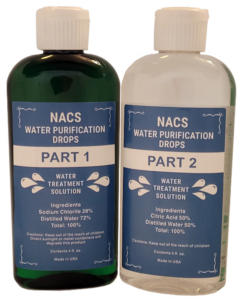
Suddenly, Herb’s Oral Reports Don’t Look Quite So Random
Now return to those stories Herb collected. Perhaps we have been framing the mystery incorrectly. The question doesn’t have to be: How could chlorine dioxide travel to the spine and repair every different back disorder?
Instead: Could an oral intervention alter something upstream that influences biological processes shared by several spinal disorders?
Now our hypothetical chain becomes:
ORAL CHLORINE DIOXIDE
↓
?
↓
intestinal microbial or chemical environment?
↓
microbial metabolites / barrier function / immune signaling?
↓
systemic inflammatory or metabolic environment?
↓
disc / joint / nerve / muscle environment?
↓
PAIN • FUNCTION • DISEASE ACTIVITY?
Notice the question marks. They’re important.
Antimicrobial Does Not Mean Microbiome-Improving
Chlorine dioxide has established oxidative antimicrobial chemistry. That makes an interaction with microorganisms biologically conceivable. But we cannot jump from: chlorine dioxide affects microorganisms to: chlorine dioxide improves the human gut microbiome.
The microbiome isn’t simply a sewer that needs disinfecting. It’s an ecosystem.
Suppressing microorganisms could theoretically be beneficial, harmful, neutral, or some complicated mixture of all three, depending on which organisms and biological processes are affected.
At present, there isn’t convincing clinical evidence establishing that orally consumed chlorine dioxide produces a predictable beneficial remodeling of the human microbiome or treats spinal disease.
That’s our missing arrow. And rather than hiding it, I’d put a spotlight on it.
That’s the experiment waiting to happen.
Then Herb Approaches the Back from the Other Direction
This is where Herb’s thinking becomes particularly interesting. He frequently didn’t stop with internal use. For many conditions, Herb favored applying chlorine dioxide “on and well around” the affected area, commonly in combination with DMSO – dimethyl sulfoxide.
At first, that might sound like another unconventional alternative-health practice. But one part of Herb’s reasoning has a surprisingly conventional pharmacological foundation.
DMSO Really Is a Penetration Enhancer
DMSO is well established in pharmaceutical science as a transdermal penetration enhancer. It can change characteristics of the skin barrier in ways that increase movement of other compounds through it.
This property isn’t merely theoretical.
DMSO has been used as the penetration-enhancing vehicle in topical diclofenac formulations used for osteoarthritis. Reviews of the clinical literature describe the DMSO-containing formulation as facilitating penetration of the active medication through the skin. PubMed
So Herb wasn’t imagining the basic carrier property. DMSO can help other substances cross the skin barrier. But that gives us another question rather than an answer.
Penetrating the Skin Isn’t the Same as Reaching a Disc
This distinction is essential. Showing that DMSO enhances transdermal penetration does not establish that chlorine dioxide mixed with DMSO:
- reaches an intervertebral disc,
- reaches a spinal nerve,
- reaches an arthritic facet joint,
- remains chemically intact while doing so,
- reaches a therapeutically meaningful concentration,
- or produces a beneficial effect after arriving.
Those would each require evidence.
And because increasing penetration can also increase exposure to unwanted substances, DMSO’s carrier property shouldn’t automatically be interpreted as evidence that an improvised chlorine-dioxide/DMSO preparation is safe.
So once again: Herb’s premise gives us a scientifically legitimate question. It doesn’t give us the answer.

Herb’s “Inside and Outside” Theory
Now we can represent Herb’s idea more accurately. He wasn’t necessarily asking one substance to accomplish one thing through one route. His approach effectively created two possible pathways.
INSIDE
oral chlorine dioxide
↓
?
↓
gut microbial / chemical environment
↓
intestinal signaling
↓
systemic immune / inflammatory / metabolic environment
↓
spinal tissue and nerve environment
And:
OUTSIDE
topical chlorine dioxide + DMSO
↓
enhanced skin penetration
↓
?
↓
local tissue exposure / distribution
↓
?
↓
local inflammatory / neural / tissue effects
And then potentially:
INSIDE + OUTSIDE
↓
shared biological response?
↓
pain • mobility • function • disease activity
That’s a considerably more sophisticated hypothesis than: “Rub chlorine dioxide on your back.”
It also contains several enormous gaps that science would need to fill. Both things can be true simultaneously.
What About Oxidation?
There’s another assumption worth challenging. When somebody hears that chlorine dioxide is an oxidizer, the natural reaction may be: Why would oxidation help a degenerating back?
That’s a reasonable concern. Oxidative stress itself participates in many degenerative and inflammatory processes.
So it would be much too simplistic to propose: oxidation = healing.
Instead, if chlorine dioxide eventually proved to influence one of these conditions, researchers would need to determine exactly what it reacted with first.
- A microorganism?
- A microbial product?
- A chemical substrate?
- Components of the intestinal environment?
- Something in superficial tissue?
- Something else entirely?
- Or nothing clinically useful?
This is precisely why the upstream approach is preferable to declaring a mechanism in advance.
One Diagnosis Doesn’t Fit Neatly Into This Story
There is one condition in Herb’s list that deserves special treatment: Spinal muscular atrophy.
SMA isn’t simply another form of degenerative back trouble. Most SMA is a genetic motor-neuron disorder involving the SMN1 gene and insufficient functional survival motor neuron protein.
That puts it in an entirely different biological category from spinal stenosis, osteoarthritis, disc degeneration, or inflammatory spondyloarthritis.
If somebody with SMA reported symptomatic improvement after chlorine dioxide, that observation could be recorded and investigated. But we shouldn’t force it into the gut-spine hypothesis merely because its name contains the word “spinal.” Nor would symptomatic improvement establish correction of the underlying genetic disorder.
That’s precisely the discipline this kind of investigation requires.
“My Back Is Better” Isn’t Enough
If we really want to know what Herb was observing, testimonials alone can’t get us there. We need measurements.
Suppose someone with degenerative disc disease begins using an investigational intervention.
Before treatment:
MRI
pain score
range of motion
walking tolerance
neurological examination
inflammatory markers where appropriate
strength and functional testing
And if we’re investigating the gut-spine hypothesis:
stool microbiome
microbial metabolites
intestinal-barrier markers
immune/inflammatory markers
Then measure again. And again.
Now imagine four different outcomes.
Outcome One: Pain Improves, MRI Doesn’t
Interesting.
The intervention may have affected inflammation, nerve irritation, pain sensitization, muscle guarding or another process without repairing the underlying structure.
Outcome Two: Inflammation Changes First
More interesting.
Now we have a possible intermediate domino.
Outcome Three: Gut Metabolites Change Before Inflammation
Very interesting.
Now our gut-spine hypothesis gains something measurable.
Outcome Four: Imaging Changes Too
Now we’re asking an entirely different question.
If objective structural improvement accompanies the clinical improvement, researchers need to investigate tissue remodeling and repair.
That’s much stronger evidence than: “My back doesn’t hurt anymore.”
Maybe the Body Finishes the Job
There’s another possibility that fits remarkably well with what we’ve been discovering throughout this series.
Back pain can create its own downward spiral.
pain
↓
less movement
↓
muscle weakness and deconditioning
↓
poorer metabolic health
↓
worse sleep
↓
increased pain sensitivity
↓
even less movement
Now suppose something interrupts that cycle.
- Pain decreases enough that the person starts walking.
- Walking improves.
- Muscles strengthen.
- Movement supports circulation and metabolic health.
- Sleep improves.
- Confidence in movement returns.
- Protective muscle guarding decreases.
- Activity increases again.
Six months later, the person may look almost nothing like the person who began the experiment. What gets the credit?
- The substance that initiated the change?
- Movement?
- Muscle recovery?
- Sleep?
- Metabolism?
- The nervous system?
- The body?
- Probably some combination.
And that brings us back to an idea we’ve encountered repeatedly: Maybe chlorine dioxide isn’t doing all the healing. Maybe something changes that allows the body to begin doing more of what it already knows how to do.
That’s still a hypothesis. But it’s considerably more biologically reasonable than imagining chlorine dioxide personally rebuilding every structure in the spine.
Maybe Herb Was Looking at Two Different Dominoes
This may be the most interesting interpretation of his inside-and-out approach. Perhaps Herb’s internal protocol was attempting – whether he knew it or not – to influence an upstream systemic environment. And perhaps his topical protocol was attempting to influence the local environment surrounding the complaint.
We now know enough to say that neither underlying concept is inherently nonsensical.
- There really is emerging research into a gut-spine axis. Frontiers
- There really is emerging research connecting gut microbial patterns with spinal stenosis. Frontiers
- There really is a substantial microbiome literature developing around axial spondyloarthritis. Frontiers
- And DMSO really is an established pharmaceutical penetration enhancer. PubMed
But none of those facts establishes chlorine dioxide as the missing therapeutic link.
That’s the distinction that lets us examine Herb’s observations respectfully without converting them into clinical proof.
From “Snake Oil” to Research Question
Unconventional practitioners frequently encounter two unhelpful extremes. One side says: “That’s impossible. Throw the whole thing away.” The other says: “It worked for somebody. Therefore the theory must be true.”
Neither approach teaches us very much. Wayne Rowland’s work gave us a similar lesson.
A person’s proposed mechanism can be wrong while an observation remains interesting. Someone can notice a real pattern before possessing the scientific tools necessary to explain it.
Conversely, somebody can also see a pattern where none exists.
There’s only one reliable way to tell the difference. Measure it.
Herb’s reported experiences don’t establish that chlorine dioxide treats degenerative disc disease, herniated discs, osteoarthritis, rheumatoid or inflammatory spinal disease, sciatica, spinal stenosis, spondyloarthritis or other spinal disorders.
But emerging research gives us considerably better questions with which to investigate those observations than we might have had years ago.
And that’s progress.
Don’t Start With “Did Chlorine Dioxide Fix the Back?”
Ask:
- Did the anatomy change?
- Did inflammation change?
- Did nerve irritation change?
- Did pain sensitization change?
- Did the microbiome change?
- Did microbial metabolites change?
- Did mobility change first?
- Did DMSO actually alter local tissue exposure?
- Did several of these dominoes move together?
And above all:
- What Changed First?
That’s the question that can transform an extraordinary recovery story into something science can actually investigate.
Maybe future research will discover that chlorine dioxide has no meaningful role in the gut-spine axis at all. Maybe researchers will discover an effect, but it won’t be the one Herb imagined. Or perhaps some small piece of Herb’s inside-and-out thinking will turn out to correspond with biological pathways we’re only now beginning to understand.
We shouldn’t decide the answer before doing the experiment.
Herb left us observations.
Modern science is beginning to provide some remarkably interesting pathways.
Now somebody needs to connect – or disconnect – the dots.
Informational notice: This article explores hypotheses and emerging research involving the gut-spine axis, DMSO and reports associated with chlorine dioxide. Chlorine dioxide has not been established as a treatment for the spinal disorders discussed here, and this article does not provide instructions for oral or topical chlorine-dioxide use. DMSO can increase transdermal penetration of other substances, which can also create safety concerns. Persistent or severe back pain, weakness, numbness, bowel or bladder changes, progressive neurological symptoms, suspected infection, or significant trauma warrant appropriate medical evaluation.
Leave a Reply